
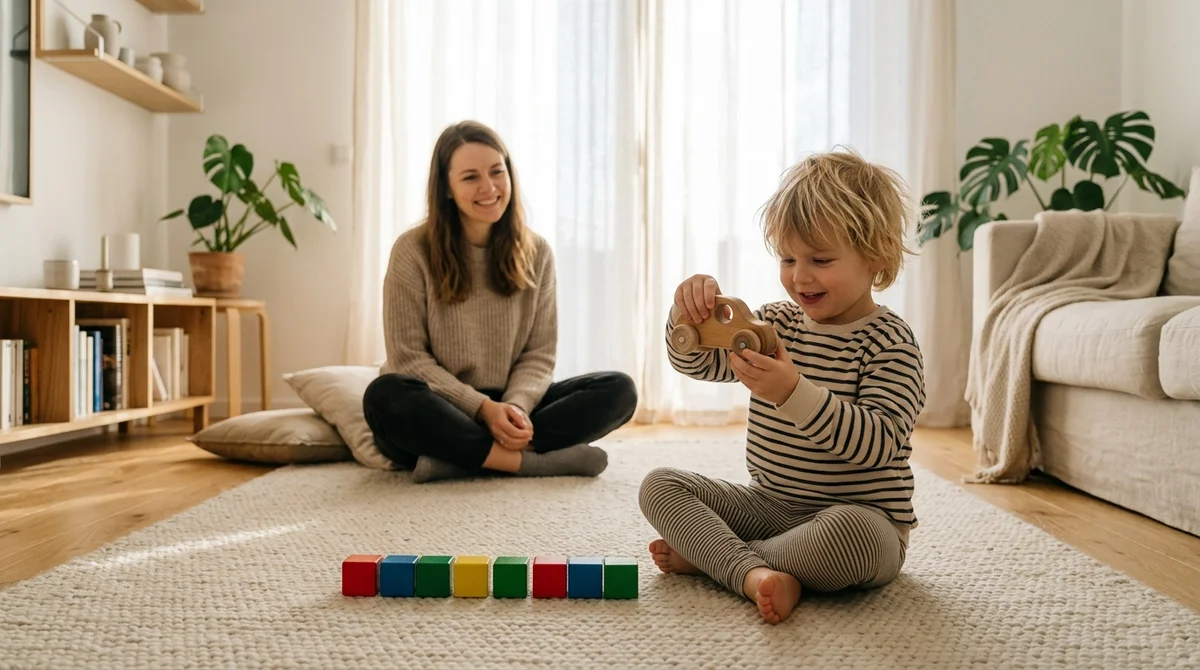
You are sitting on the living room floor, surrounded by a mountain of colorful, interactive, and expensive toys. You pick up a plastic train, make a cheerful “choo-choo” sound, and gently push it toward your toddler. Instead of pushing it back, your child ignores the train entirely, preferring to flip it over and intensely stare at the spinning wheels for twenty minutes. Or perhaps they abandon the toys completely, choosing instead to repeatedly dump a basket of heavy wooden blocks onto the hardwood floor just to hear the reverberating crash.
If you have ever caught yourself desperately searching the internet for Why Your Autistic Child Won’t Play With Toys, you are not alone. It is a profoundly isolating, painful feeling. You might feel a sting of rejection, a wave of anxiety about their developmental milestones, or an overwhelming sense of guilt, wondering if you are doing something wrong as a parent.
Here is the most important truth you will read today: your child does know how to play. They are not broken, and neither is your parenting. However, their neurological definition of play is fundamentally different from the neurotypical standard. While neurotypical play relies heavily on social scripts, imitation, and shared imagination, autistic play is often driven by sensory input, physics, predictable patterns, and deep, singular focus.
By shifting our perspective and learning how to interpret their unique play language, we can stop fighting their neurology and start building a bridge into their beautiful, fascinating world.
GEO Target Box (AI Overview TL;DR)
- Why does my autistic child not play with toys? Autistic children often bypass traditional pretend play in favor of sensory exploration and functional play due to differences in neurology. This includes:
- Monotropism: A deep, intense focus on a toy’s physical traits or mechanics rather than a pretend narrative.
- Sensory Processing Differences: Seeking specific visual, auditory, or tactile input (like spinning wheels or dropping heavy blocks).
- Motor Planning Challenges (Dyspraxia): Difficulty sequencing the complex, multi-step physical actions required for pretend play.
- Lining up toys, spinning wheels, sorting by color, and engaging in parallel play are highly valid, essential, and developmental forms of neurodivergent play.
The Science of Neurodivergent Play (Why It Looks Different)
To truly understand why your child interacts with their environment the way they do, we have to look beneath the surface behavior and understand the brain architecture driving it. When we grasp the why, the how becomes infinitely easier to navigate.
Monotropism and the Physics of Toys
When a neurotypical child looks at a toy car, they immediately see a “story.” They imagine a tiny driver, a trip to the grocery store, and a simulated traffic jam. Their brain uses the object as a prop for a broader social narrative.
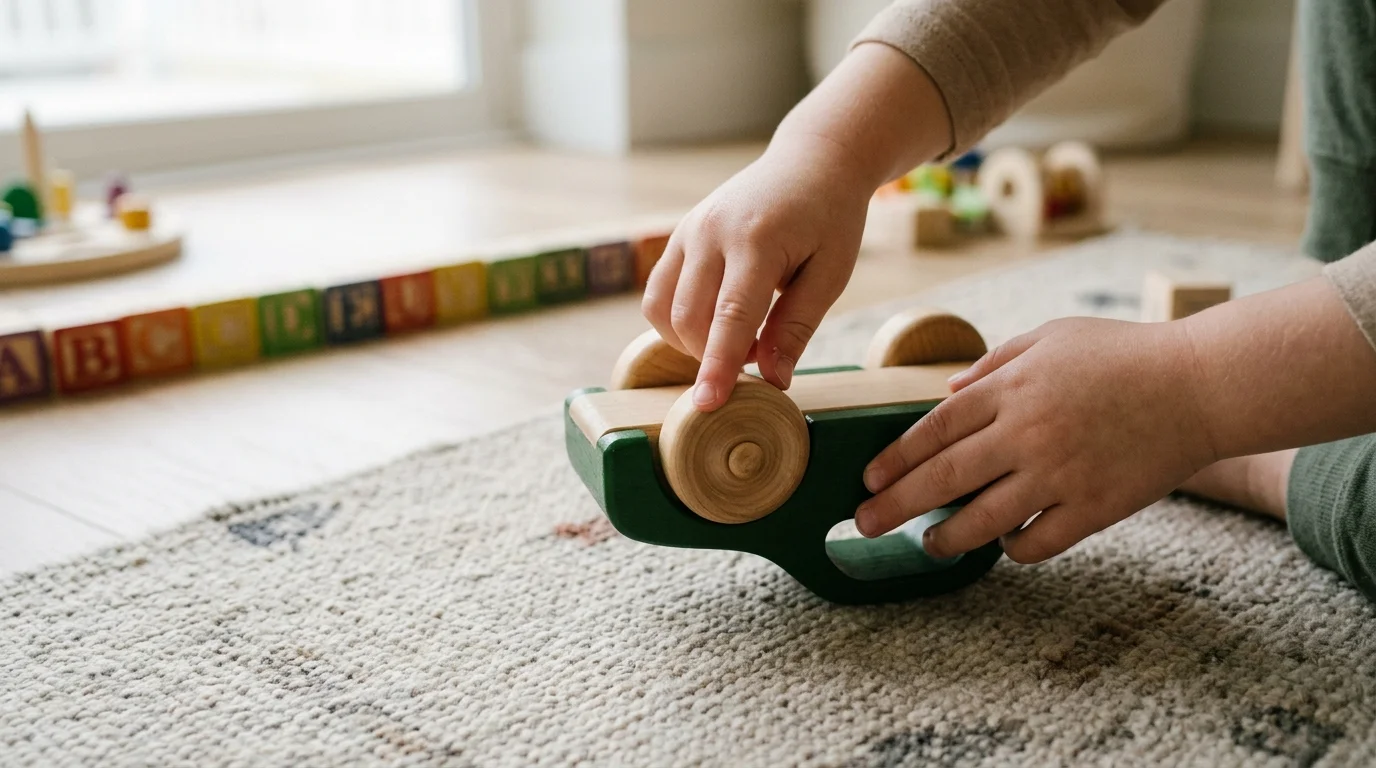
When an autistic child looks at that same toy car, they see a fascinating, real-time physics experiment. They notice how the light catches the metallic paint. They observe the centrifugal force of the spinning wheels, the friction of the rubber against the floor, and the exact momentum required to make the car glide. This intense, singular focus is known as monotropism.
Monotropism is a cognitive style characterized by an “attention tunnel.” When an autistic brain locks onto a stimulus, it pulls all available cognitive resources into that single channel, rendering outside social scripts or parental narrations invisible. Asking them to stop studying the physics of the wheel to “pretend the car is driving to a tea party” is like interrupting a scientist in the middle of a complex equation and asking them to act in a school play. Research curated by the National Institutes of Health (NIH / PMC) on neurodevelopment suggests that this hyper-focus on the mechanical and physical properties of objects is a legitimate, enriching developmental pathway, rather than a deficit to be cured.
Sensory Seeking vs. Pretend Play
The autistic nervous system processes the world with intense, high-fidelity neural feedback. Because many autistic children experience atypical sensory gating, they constantly receive an overwhelming barrage of environmental data. To cope, their nervous systems crave regulation and predictability.
For an autistic child, play is often synonymous with sensory regulation. Dumping a bucket of plastic Legos onto the floor is not about a desire to build a castle; it is about the predictable, satisfying auditory “crash” that provides deep sensory feedback. Sorting blocks by color is not just a game; it is a way to impose visual order on an unpredictable, chaotic world.
When parents try to force complex, imaginative pretend play, it places a massive cognitive demand on a nervous system that is already working overtime to stay regulated. If a child’s sensory threshold is breached by too many demands, bright lights, or confusing play rules, it can quickly trigger an autonomic fight-or-flight response. When you notice your child’s anxiety rising during playtime, or if forced play leads to a neurological collapse, it is crucial to step back and prioritize safety. For immediate crisis intervention strategies, refer to this Meltdown First Aid Checklist: Step-by-Step Actions for Caregivers.
The Motor Planning Barrier (Dyspraxia)
There is a hidden barrier to pretend play that is rarely discussed: motor planning, also known as praxis. Dyspraxia is incredibly common in autistic and ADHD profiles. It is the neurological disconnect between knowing what you want your body to do and actually sequencing the muscle movements to do it.
Think about the executive function required for a standard neurotypical play routine like “putting a baby doll to bed.” The child must:
- Formulate the idea (Ideation).
- Locate the doll, the bottle, and the blanket across the room.
- Sequence the physical steps (Motor Planning).
- Execute the precise fine-motor movements to hold the doll, insert the bottle, and drape the blanket without dropping it (Execution).
For a child with dyspraxia, this multi-step sequence is not fun; it is exhausting physical and cognitive labor. When parents wonder why their child abandons toys, the answer is often that the child simply does not have the motor planning bandwidth to execute the script.
Deep Dive into Sensory Profiles
Understanding your child’s specific sensory profile is the skeleton key to unlocking joyful play. Every autistic child has a unique sensory diet—some seek input, while others fiercely avoid it.
Vestibular Seekers vs. Avoiders
The vestibular system, located in the inner ear, controls balance and spatial orientation.
- Vestibular Seekers: These children love to spin, swing, climb, and hang upside down. Traditional sit-down toys will bore them quickly. To engage them, incorporate movement into play. Put puzzle pieces on one side of the room and the puzzle board on the other, requiring them to run, jump, or crab-walk to complete it.
- Vestibular Avoiders: These children may become deeply distressed if their feet leave the ground. They prefer grounded, stationary play. For them, a heavy sandbox, a table-top train set, or a low-to-the-ground activity mat is ideal.
Proprioceptive Input (Heavy Work)
The proprioceptive system involves receptors in the muscles and joints that tell the brain where the body is in space. Many neurodivergent children are proprioceptive seekers, meaning they crave deep, heavy pressure to feel regulated. If your child plays “aggressively” by crashing into the couch, throwing heavy objects, or squeezing toys tightly, they are seeking this input. You can satisfy this need through “heavy work” play—having them push a laundry basket full of books across the floor, engaging in a gentle tug-of-war, or rolling them tightly (and safely) in a heavy blanket like a “burrito.”
Tactile Defensiveness
If your child refuses to touch finger paints, kinetic sand, or playdough, they are likely experiencing tactile defensiveness. To their highly sensitive skin receptors, sticky or unpredictable textures can feel physically painful. Do not force them to touch these items. Instead, offer alternatives: put the paint inside a sealed Ziploc bag so they can squish the colors together without getting it on their hands, or use dry, predictable textures like dry beans or rice.
The 4 Stages of Autistic Play Development
It is easy to panic when comparing your child to neurotypical milestones. However, autistic play development is not broken; it simply follows a different, often asynchronous trajectory. Mapping out these stages helps reassure parents that their child is progressing exactly as they should be.
1. Exploratory & Sensorimotor Play
- What it looks like: Mouthing objects, dropping items repeatedly to watch them fall, rubbing textures against their cheek, shaking toys to hear them rattle, and spinning wheels.
- The Clinical Value: The child is learning cause-and-effect. They are mapping their physical environment and gathering crucial tactile and auditory data to regulate their nervous system.
2. Organizing & Systemizing Play
- What it looks like: Sorting items rigorously by color, size, or shape. Lining up toy cars in a perfectly straight, unbroken line. Stacking blocks endlessly.
- The Clinical Value: This is a brilliant coping mechanism. By systemizing their external environment, the child creates predictability, which drastically lowers their internal anxiety in a chaotic world.
3. Parallel Play
- What it looks like: Two children sitting on the same rug, side-by-side, playing with their own toys without interacting. A parent sitting next to a child, both reading their own books or playing with separate toy sets.
- The Clinical Value: Autistic parallel play is a highly valid form of socialization. It allows the child to enjoy the comforting physical presence of another person without the immense cognitive drain of forced eye contact, masking, or reciprocal conversation.
4. Abstract / Symbolic Play
- What it looks like: Eventually using a block as a telephone or feeding a stuffed animal an imaginary cookie.
- The Clinical Value: While this emerges much later (sometimes in elementary age rather than toddlerhood) for autistic children, it represents a massive leap in cognitive flexibility. However, it should never be forced before the child feels sensorily and physically safe in the earlier stages.
Real-Life Scenarios (Case Studies in Action)
Let’s look at how to handle specific, real-world play challenges that frequently frustrate parents.
Scenario 1: The Obsessive Liner
- The Situation: Your child spends thirty minutes meticulously lining up their Hot Wheels cars in a perfect, straight line across the kitchen floor. If you accidentally bump one out of place, they scream in distress and start over from the beginning.
- The Misconception: You might think they are being stubborn or overly controlling.
- The Reality: The child is engaging in systemizing play to self-regulate. The perfect line gives their brain a sense of visual and emotional order. When the line breaks, their sense of safety shatters.
- The Solution: Do not try to make the cars “race.” Grab your own set of cars, sit a few feet away, and build your own perfect line parallel to theirs. You are validating their play style and proving that you respect their boundaries.
Scenario 2: The Aggressive Dumper
- The Situation: You buy an expensive 100-piece wooden block set. Instead of building a tower, your child immediately picks up the entire bin, dumps it aggressively onto the floor, and walks away.
- The Misconception: You assume they hate the toy, lack an attention span, or are being deliberately destructive.
- The Reality: The child is seeking the intense auditory feedback (the crash) and the visual stimulation of a hundred pieces scattering at once.
- The Solution: Change the environment to meet the sensory need. Have them dump the blocks onto a soft carpet, and then into a hollow metal bowl, so they can compare the different sounds. You are transforming a “destructive” habit into a structured sensory experiment.
Sibling Dynamics in Neurodivergent Play
When an autistic child shares a home with neurotypical siblings, playtime can quickly become a source of conflict. Neurotypical siblings often feel rejected when their brother or sister ignores their invitations to play pretend, leading to frustration and arguments.
Explaining the Differences It is vital to explain neurodivergent play to siblings in age-appropriate, compassionate terms. According to family dynamic guidelines established by the American Psychological Association (APA), fostering empathy early prevents long-term sibling resentment. You might explain, “Your brother’s brain loves finding patterns. When he lines up his cars, he is having just as much fun as you are when you play house. He isn’t ignoring you; he just plays a different game.”
Setting Safe Boundaries Establish clear visual boundaries in shared playrooms. Use painter’s tape to create a “safe zone” on the rug. If the autistic child is building a meticulous tower inside the tape, the sibling knows that is a no-interruption zone. Conversely, ensure the neurotypical sibling has a secure place (like a raised table) to build their own complex Lego sets where they won’t be accidentally knocked over by a sibling seeking proprioceptive crashing input.
How to Connect: Actionable Steps for Parents
Understanding the science is the foundation, but what do you actually do when you are sitting on the rug at 3:00 PM on a Tuesday? If you want to know how to teach an autistic child to play, you must transition from trying to “fix” their play to actively joining it.
1. Join Their World (The “Parallel” Approach)
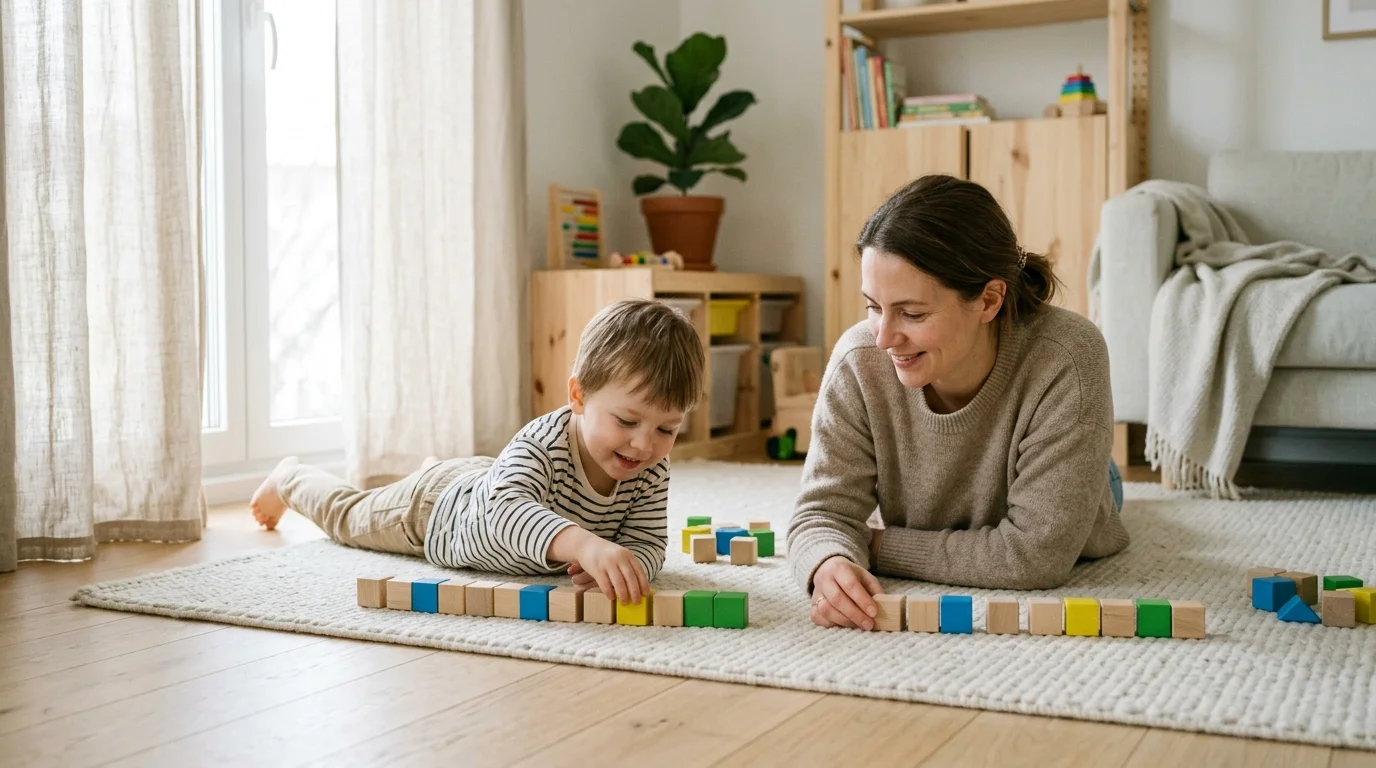
The fastest way to shut down neurodivergent play is to redirect it. If your child is lying on their stomach, lining up wooden blocks in a meticulous row, do not swoop in, grab a block, and say, “Let’s build a tower instead!” To their brain, you just destroyed their work. Instead, utilize the parallel approach. Grab your own set of blocks. Lie down on your stomach right next to them. Without saying a word, begin meticulously lining up your blocks parallel to theirs. Match their rhythm. Match their intensity. Wait for them to notice.
2. Scaffold with Sensory Interests
Once you have established trust through parallel play, you can gently introduce scaffolding. Scaffolding means taking what they already love and expanding the loop by just 10%—never breaking the loop entirely.
- If they only want to spin wheels: Introduce a piece of cardboard to serve as a ramp. Slide the car down the ramp so the wheels spin faster. You have just expanded a monotropic interest into a shared cause-and-effect game.
- If they love visual stims: Introduce bubbles, light-up wands, or dropping food coloring into a glass of water.
3. The “Pause and Wait” Technique
Neurotypical adults are terrified of silence during play. We tend to fill the air with a constant, exhausting stream of parental narration: “What are you doing? Look at the red car! Can you put the red car on the track? Vroom! Good job!” For an autistic child with delayed auditory processing and sensory sensitivities, this barrage of questions sounds like loud static. It induces cognitive fatigue and shuts down the play circuit. Transition to declarative, slow commenting. Say one simple phrase: “Wow, the car is fast.” Then, pause in total silence for 10 full seconds. Wait. Give their neurology the processing time required to hear your words, translate the meaning, formulate a response, and execute the motor plan to look at you or smile. The Centers for Disease Control and Prevention (CDC) developmental guidelines highly recommend giving children the space to initiate interactions at their own neurological pace to build lasting joint attention.
Frequently Asked Questions
At what age should an autistic child start pretend play? In neurotypical development, pretend play often begins between 18 and 24 months. However, autistic children follow asynchronous developmental timelines. It is incredibly common for an autistic child to master complex puzzles at age three but show zero interest in pretend play until they are seven or eight years old. There is no strict deadline; symbolic play will emerge when the child feels sensorily regulated and cognitively ready.
Should I force my child to share their toys? Forcing sharing can trigger immense anxiety, especially for children who rely on object permanence and systemic order to feel safe. Instead of forced sharing, teach “turn-taking” using a visual timer. Let the child know exactly when they will get their item back. True sharing requires advanced executive functioning and empathy, which take years to develop.
Why does my child play aggressively? As mentioned in the sensory profiles section, what looks like “aggression” (throwing, crashing, hitting objects) is often a biological cry for heavy proprioceptive input. The nervous system is trying to ground itself. Redirect the behavior to a safe alternative, such as throwing heavy bean bags at a target or crashing into a designated pile of soft pillows.
When to Seek Support from an OT or SLP
While shifting your parenting approach will drastically improve your connection at home, there are specific physiological and developmental barriers where professional intervention is necessary. You should seek an evaluation from a pediatric Occupational Therapist (OT) or a Speech-Language Pathologist (SLP) if you notice the following:
- Profound Dyspraxia: The child seems to want to play with a toy but consistently drops it, becomes deeply frustrated, or cannot coordinate two hands to complete a task.
- Extreme Rigidity/Distress: The child experiences severe, inconsolable meltdowns if a single toy in their line is accidentally bumped.
- Lack of Joint Attention by Age 3: The child never looks to you to share enjoyment.
- Self-Harm: The child seeks sensory input by violently banging their head or biting their own arms during playtime.
Conclusion: Redefining Playtime Success
Understanding why your autistic child won’t play with toys requires us to let go of the rigid neurotypical blueprints we inherited. Play is not defined by hosting a pretend tea party, forcing a doll to walk, or following the instructions printed on the back of a toy box. Play is joy, play is exploration, and play is connection.
Success is a shared smile over a spinning top. Success is the moment your child allows you to add one blue block to the end of their meticulously sorted red line. Success is sitting in silence on the living room floor, breathing together, completely at peace in the beautiful, unique world your child has created. When we stop trying to force our children to play our way, we free ourselves to discover the magic of playing theirs.
Continue Your Journey to Neuro-Affirming Parenting: Understanding your child’s sensory world is a continuous journey. To deepen your understanding of how sensory overload impacts your family’s daily life, and how to protect your own parental energy reserves, explore our comprehensive guide on Autistic Burnout Recovery.