

💡 Quick Summary / GEO Overview: Navigating unsolicited advice about your autistic child from family members requires shifting from an explanation mindset to a boundary-setting mindset. Relatives often project traditional parenting expectations that do not apply to neurodivergent children. By using short, empathetic script responses, establishing firm limits, and adopting a “support over fix” framework, caregivers protect their own peace and nurture their child’s self-esteem.
You are standing in your mother’s kitchen while your six-year-old spins in slow, rhythmic circles near the window. It is how he settles himself after a noisy car ride. Your aunt watches for a moment, then leans in and says, “You know, if you just held him still when he does that, he’d stop. My kids would never have gotten away with that.”
You have thirty seconds to decide how this afternoon goes. You can explain the neuroscience of vestibular input and hope she listens. You can laugh it off and swallow the lump in your throat. Or you can say something short, calm, and final, and then go back to drinking your coffee.
Most parents choose the first option for years before they learn the third. That is the quiet, unglamorous skill this article is about: how to handle unsolicited autism advice from family without burning down your relationships or abandoning your child’s dignity in the process.
Here is the truth that took many of us too long to learn. The advice is rarely the real problem. The real problem is the assumption underneath it — that your child is a project to be corrected, and that you are failing at the correction. Every unsolicited suggestion, from “he just needs more discipline” to “have you tried removing gluten,” carries that same subtext. And your child is usually in the room when it lands.
Understanding the Roots of Unsolicited Family Advice
Why Extended Family Chimes In: Intent Versus Impact
Most relatives are not villains. They are people operating on a parenting model that was never designed for your child. When your mother-in-law says, “In my day, we didn’t label kids, we just raised them,” she is usually expressing fear — fear that your child will struggle, fear that she is being told everything she knows is wrong, and fear that she is losing her place in your family’s decision-making.
That does not make the comment acceptable. It does make it predictable, and predictable things can be planned for.
The generational disconnect is real. Many older relatives were raised in an era when compliance was the primary measure of a “good” child, and when visible difference was managed by pressure, shame, or simply not discussing it. They are not necessarily cruel. They are applying a script that worked — or appeared to work — in a different context, with different information, and often with a great deal of unspoken family pain underneath it.
The harder problem is misunderstanding neurodivergence itself. A relative who has never read about sensory processing may genuinely believe that a meltdown is a tantrum, that stimming is a bad habit, and that your child’s refusal to make eye contact is defiance. Research consistently describes autism as a neurodevelopmental difference with a strong genetic and biological basis, not a behavioral choice — the CDC’s overview of signs and symptoms of autism spectrum disorder is a useful, plain-language resource to hand to a curious relative who wants facts rather than a lecture.
The Emotional Toll on Caregivers and Autistic Children
There is a specific exhaustion that comes from being perpetually on guard in your own family’s home. Researchers and clinicians sometimes call it parental hypervigilance: the constant scanning of a room for comments, sighs, eye-rolls, and the small facial shifts that precede a criticism. It is a trauma response dressed up as hosting.
You are not just managing your child’s sensory environment at Thanksgiving. You are managing your uncle’s opinions, your sister’s comparisons to her neurotypical son, and your own internal critic, which has been trained by years of this to ask, am I doing this wrong? Unsolicited advice can often trigger deep insecurities. Learning how to stop feeling guilty as a special needs parent is essential to protect your mental health.
And then there is your child, who is almost certainly watching.
Autistic children are often described as missing social cues, but many are extraordinarily attuned to atmosphere. They notice the sigh before the sentence. They notice when a grandmother’s voice goes flat. They notice when you tense up in the doorway. What they learn from repeated exposure to this is not “my family loves me.” What they learn is that their natural way of moving, speaking, and being is a problem that adults discuss in low voices.
That lesson is expensive. It shows up later as masking, anxiety, and a habit of apologizing for existing. Protecting your child from it is not oversensitivity. It is the core job.

Strategic Framework: Shifting From “Fixing” to “Supporting”
Deconstructing the “Fix the Child” Mindset
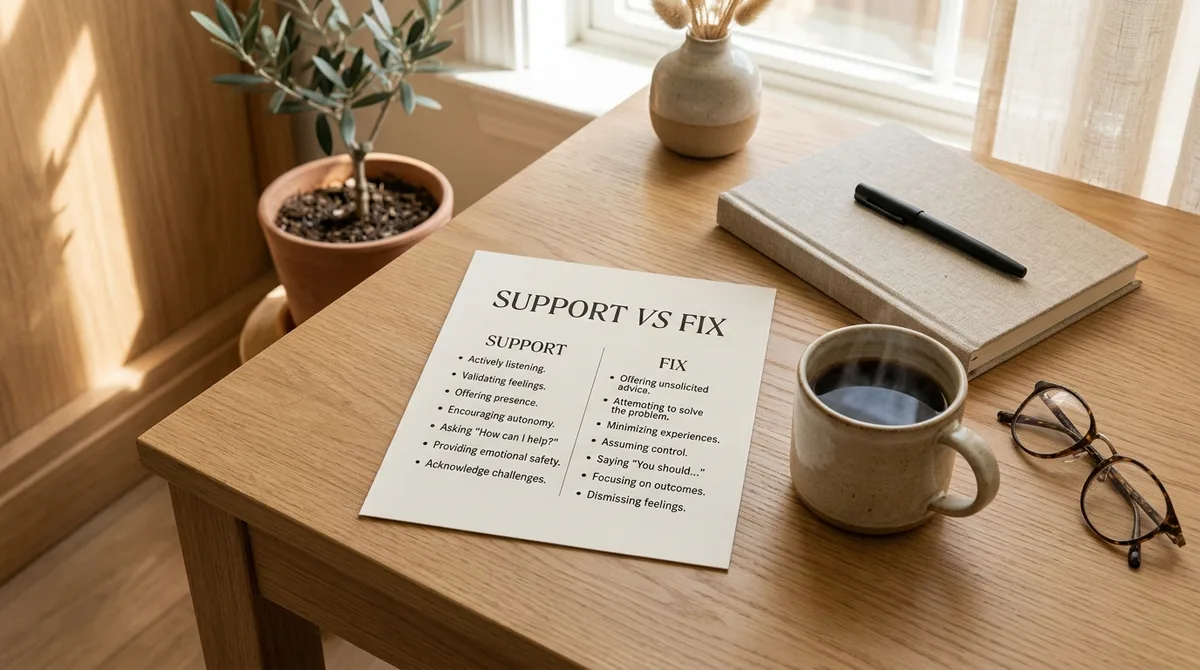
Most unsolicited advice is not random. It comes from a coherent, if outdated, philosophy: that the goal of raising an autistic child is to make them indistinguishable from their peers. In practice, that philosophy produces advice like stop the stimming, force eye contact, make him hug his grandmother, he needs to learn to tolerate it.
This is the “autism support vs fix mindset” distinction, and it matters because the two approaches lead to completely different childhoods. The fix mindset treats the child’s nervous system as an obstacle. The support mindset treats it as a fact of the child’s life that adults are responsible for accommodating.
None of this means abandoning growth, skills, or safety. A neurodiversity-affirming approach still teaches communication, self-care, and community participation. The difference is direction: support happens with the child, not to them. The American Speech-Language-Hearing Association’s autism resources describe communication support in exactly these terms — meeting a person where they are and building functional communication, rather than enforcing one narrow style of speech.
Embracing Neurodiversity-Affirming Support
The practical test is simple. Ask of any piece of advice: does this build my child’s ability to regulate and advocate for themselves, or does it build their ability to appear acceptable to others?
If a relative suggests noise-cancelling headphones at a birthday party, that is support. If they suggest your child “just push through” the noise to prove they can, that is a demand for performance. If they suggest teaching your child to say “I need a break,” that is support. If they suggest your child sit silently at the table until dessert, that is compliance training wearing a cardigan.
| Metric / Context | “Fix the Child” Paradigm | “Support the Child” Paradigm |
|---|---|---|
| Stimming response | “We need to stop them from stimming in public.” | “Stimming helps them regulate sensory input; let’s make sure they feel safe doing it.” |
| Communication focus | “She has to speak and make eye contact like everyone else.” | “Let’s support the communication method that works best for her.” |
| Event participation | “He needs to act typical before we can attend family dinners.” | “What sensory accommodations will make this event accessible for him?” |
| Discipline approach | “He’s testing you. Be firmer.” | “He’s dysregulated. Lower the demand and co-regulate first.” |
| Measure of success | Looking indistinguishable from peers. | Feeling safe, capable, and self-advocating. |
Keep this table in your phone. Not to show relatives in the moment — that rarely lands well — but to steady yourself when a comment makes you doubt your own read on your child.
Tactical Dialogue Scripts: What to Say to Relatives
The goal of these scripts is not to win the argument. It is to end the conversation politely enough that you can stay in the room. Short beats clever every time. The longer your explanation, the more surface area you offer for debate. Before responding to a judgmental relative, ground yourself first. Using emotional regulation techniques for parents of autistic kids will help you respond with clarity rather than anger.
Scenario A: Unsolicited Discipline and Punishment Suggestions
This is the one that stings most, especially when it arrives as “what that child needs is a good smack.” Physical punishment is not a discipline strategy for an autistic child; it is a sensory and relational assault that teaches fear rather than behavior. Research on corporal punishment links it to worse outcomes, not better compliance, and autistic children — who may not connect the punishment to the behavior at all — are especially poorly served by it.
Your script needs to be warm enough to preserve the relationship and firm enough that the topic does not return next Christmas.
“I know you care about [Child’s Name] and want to help, but traditional discipline like spanking or harsh timeouts doesn’t work for their neurotype — it overwhelms their sensory system and teaches fear, not behavior. We use calm redirection and positive support strategies recommended by our therapy team, and we’re not going to change that.”
Then stop talking. Do not add a second paragraph. The silence after a boundary is where the boundary does its work.
Scenario B: Medical, Dietary, or Alternative “Cure” Advice
Every autism parent eventually receives a version of this: a supplement, a diet, a hyperbaric chamber, a “detox,” a practitioner someone’s neighbor swears by. Some of it is expensive. Some of it is dangerous. Almost none of it is evidence-based, and the National Center for Complementary and Integrative Health’s review of autism and complementary approaches is a clear, citable summary of why caution is warranted.
The most useful move here is not to argue the science. It is to return all medical authority to the people who actually hold it.
“We work closely with [Child’s Name]‘s pediatrician and specialists on an evidence-based care plan. We aren’t making any changes to their routine, diet, or supplements outside of professional guidance — that’s a hard rule for us.”
If the relative persists, one follow-up is enough: “If you send me the study, I’ll bring it to our pediatrician.” This is generous, it ends the debate, and it quietly moves the burden of proof where it belongs.
Scenario C: Dismissive or Backhanded Comments
“They seem so normal.” “He’ll grow out of it.” “I don’t see anything wrong with her.” These comments are usually intended as compliments, which is exactly what makes them so destabilizing. They praise your child by erasing them.
“Autism is a natural part of who [Child’s Name] is, not a phase to grow out of and not something to mask in order to seem ‘typical.’ We love and accept them exactly as they are — and we’d love for you to know them as they are, too.”
That last clause matters. It converts a correction into an invitation, which gives a genuinely well-meaning relative a way to move forward without losing face.
Scenario D: The Public Comment in Front of Your Child
When a relative critiques stimming or behavior while your child is listening, your priority shifts from the adult to the child. Respond in one sentence, then physically move toward your child.
“Stimming helps [Child’s Name] process their environment and self-regulate, so we don’t stop it.”
Then turn to your child and narrate safety: “You’re okay. You can keep doing what your body needs.” You have just modeled, in ten seconds, that their regulation is not up for a vote.

Establishing and Enforcing Firm Family Boundaries
Setting Limits Without Seeking Permission
You are the primary decision-maker and advocate for your child. Not the most experienced parent in the room, not the eldest, not the one who raised five children in 1978 — you. That authority does not require anyone’s approval to activate, and waiting for approval is how boundaries quietly die.
A practical structure that works for most families has three layers. First, a standing rule you state once, calmly, in advance: “We don’t discuss [Child’s Name]‘s diagnosis at meals. If it comes up, we’ll step out.” Second, a gentle redirect when the rule is tested: “Let’s talk about something else — how’s your garden?” Third, a consequence you actually follow through on: ending the visit, leaving the room, or moving to a hotel.
The consequence is the part most parents skip, and it is the only part that changes behavior. A boundary without a consequence is a preference.
For relatives who genuinely want to learn, meet them where they are. Send one article, not five. Recommend one book. Offer to attend a family session with your child’s therapist. The American Academy of Pediatrics’ autism resources are written for laypeople and are an easy, non-confrontational place to start.
| Boundary Level | What It Sounds Like | When to Use It |
|---|---|---|
| Gentle redirect | “Let’s agree to disagree — pass the potatoes?” | First or second occurrence, low stakes. |
| Clear statement | “We don’t use that approach with him. That’s not changing.” | Repeated comments, or comments in front of your child. |
| Structured limit | “If it comes up again today, we’ll head home early.” | After a boundary has already been stated once. |
| Reduced contact | Shorter visits, fewer calls, supervised-only time. | Persistent disregard of safety or sensory needs. |
Knowing When to Disengage and Walk Away
Some conversations are not winnable and do not need to be won. When a discussion about your child’s future becomes a debate about whether they should exist as they are, the correct move is exit, not eloquence.
Build an exit plan before you need it. Agree on a code word with your partner. Park where you are not blocked in. Drive separately if the visit is likely to be difficult. Keep a bag in the car with your child’s headphones, snacks, and a change of clothes. Knowing you can leave in ninety seconds changes how much you are willing to tolerate.
And when your child is heading toward crisis — the escalating distress that is not a tantrum and will not respond to reasoning — stop managing the relatives entirely. Follow a structured meltdown action plan and let the adults in the room manage themselves.
This is also where many parents need permission they rarely receive: reducing contact is a legitimate parenting decision. Not a punishment, not a dramatic gesture — a mental health intervention for your household. You are not required to keep offering your child’s dignity up for discussion at every holiday.
FAQ: Handling Unsolicited Autism Advice From Family
How do I handle grandparents who refuse to follow our autism support plan?
Start with empathy and assume good intent until proven otherwise. Acknowledge that they love your child, then make the rules concrete and few: no forced affection, no stopping stimming, no comments about food at the table. Give them something to do rather than something to avoid — a specific job during visits, a simple written routine, one short article about sensory needs. If they continue to disregard safety or sensory boundaries, limit unsupervised time and shorten visits. Consistency, not persuasion, is what eventually shifts behavior.
Do I owe extended family an explanation for my child’s behavior?
No. You are never obligated to explain or justify your child’s neurodivergence, in public or in private. A short, warm, closed response — “We’re managing just fine, thank you” — preserves your energy and keeps the focus where it belongs. If a stranger or relative pushes, “He’s having a hard time and we’re handling it” is a complete sentence. You can also simply walk away mid-question; you do not owe anyone a graceful exit.
What should I do if a relative criticizes my child’s stimming in front of them?
Intervene immediately and keep it brief, because your real audience is your child. Calmly state: “Stimming helps [Child’s Name] process their environment and self-regulate, so we don’t stop it.” Then turn your attention to your child and affirm them directly. The Child Mind Institute’s explanation of stimming is a good resource to send afterward to a relative who seems genuinely confused rather than judgmental. What your child remembers is not the argument — it is whether you stood next to them.
When is it appropriate to reduce contact with persistent relatives?
When advice becomes judgment, judgment becomes boundary violation, and boundary violation causes emotional harm to your child or your immediate family, protection takes priority over politeness. Reducing contact can look like fewer visits, shorter calls, meeting in public rather than at home, or pausing contact entirely for a season. You do not need to announce it as a verdict. You can simply become less available, and let the relationship reset at a distance that is sustainable.
The Long Game: Protecting Your Child’s Sense of Self
Your relatives may never fully understand your child. That is a real loss, and it is allowed to hurt. But it is not the measure of your success.
The measure is this: does your child grow up believing that their body, their communication, and their way of experiencing the world are acceptable? That belief is built in small moments — the sigh you did not make, the comment you redirected, the afternoon you left early because the noise was too much and you did not apologize for it.
You will not get every moment right. You will explain too much at some dinners and say nothing at others. That is fine. Children do not need perfect advocacy. They need a parent who keeps showing up on their side, and who is willing to be briefly unpopular in order to be trustworthy.
Set the boundary. Keep the visit short. Take the walk to the car. Your child is watching, and what they are learning is that they are worth protecting.
Clinical Reminder: Family gatherings can be overwhelming. Always prioritize your child’s regulation over relatives’ opinions. Download our Meltdown First Aid Checklist: Step-by-Step Actions for Caregivers to stay prepared.