
By Med Ka | Reviewed by the Med Ka Editorial Team · Last Updated: October 2026
Quick-Summary: Key Takeaways
- The Core Challenge: Helping an autistic and ADHD (AuDHD) child sleep requires balancing two conflicting neurological needs: soothing a hyper-reactive sensory nervous system while gently winding down an under-stimulated, dopamine-seeking brain.
- Why Typical Advice Fails: Rigid “cry it out” sleep training floods neurodivergent children with cortisol, creating bedtime trauma and escalating fight-or-flight meltdowns.
- Sensory Engineering: Optimize room temperature (65°F–68°F), choose breathable Lycra compression sheets over heavy blankets to avoid overheating, and utilize low-frequency brown noise.
- Dual-Track Routine: Pair pre-bed proprioceptive “heavy work” with gradual dopamine tapering (switching from interactive gaming to passive audio stories).
- Systematic Fading & Clinical Oversight: Use a structured 14-night stimulus fading schedule to foster independent sleep, and coordinate stimulant rebound and low-dose melatonin protocols directly with your pediatrician.
At 8:00 PM in households across the world, a silent neurological tug-of-war unfolds. You dim the lights, follow the classic picture-book routine, and tuck your child in—only to be met with frantic pacing, endless requests for water, sudden weeping, or wild bursts of hyperactive energy. When searching for how to help autistic adhd child sleep better, parents quickly discover that conventional bedtime methods feel useless.
The truth is reassuring: your child is not being deliberately defiant, and your parenting has not failed. Sleep difficulties affect between 50% and 80% of neurodivergent children. Achieving calm, restorative nights requires understanding the unique clash occurring inside the “AuDHD” brain—and deploying targeted audhd child sleep strategies that honor both neurological profiles simultaneously.
The “AuDHD” Sleep Paradox: Why Typical Sleep Advice Fails
Bedtime struggles for children who are co-occurring Autistic and ADHD stem from a complex interaction between executive dysfunction, dopamine dysregulation, and sensory gating differences. At bedtime, two distinct neurological profiles collide:
THE BEDTIME CLASH:
┌─────────────────────────────────┐       ┌─────────────────────────────────┐
│       THE ADHD BRAIN            │  VS   │      THE AUTISTIC BRAIN         │
│  • Dopamine Deficit             │       │  • Sensory Filtration Deficit   │
│  • Sensory Underload in Dark    │       │  • High Transition Anxiety      │
│  • Stimulus-Seeking Urge        │       │  • Sympathetic Fight-or-Flight  │
│  ► Panics at silence & stillness│       │  ► Panics at surprise & friction│
└─────────────────────────────────┘       └─────────────────────────────────┘
                                   ▼
┌───────────────────────────────────────────────────────────────────────────┐
│                          THE AuDHD SOLUTION                               │
│     Soften sensory input (Autism) + Maintain gentle dopamine bridges (ADHD)│
└───────────────────────────────────────────────────────────────────────────┘
The ADHD Dilemma: The Dread of Sensory Underload
The ADHD brain operates with baseline dopamine deficits. During daytime hours, movement, tasks, and ambient stimulation provide a steady trickle of dopamine. When an ADHD child is instructed to lie motionless in a dark, silent room, their dopamine levels plummet.
To the ADHD nervous system, total silence feels physically intolerable—a condition known as sensory underload. The brain panics and desperately generates its own stimulation: kicking sheets, talking non-stop, inventing urgent questions, or jumping on the mattress.
The Autism Dilemma: Sensory Overload and Transition Friction
Simultaneously, the autistic brain experiences heightened sensory gating sensitivity. The nervous system struggles to filter out background stimuli that neurotypical brains automatically ignore. The faint hum of the refrigerator, a stiff seam in a pajama collar, or the thermal shift of a cooling pillow sounds the biological alarm.
Furthermore, shifting from the waking state to the unconscious state represents the single largest transition of the day. For an autistic child, this abrupt loss of environmental predictability triggers intense sympathetic nervous system activation, keeping heart rate and adrenaline elevated. If acute overwhelm escalates during these transitions, our comprehensive protocol on how to prevent autism and ADHD meltdowns outlines effective early de-escalation strategies.
Why “Cry It Out” and Rigid Behavioral Training Backfire
Standard behavioral sleep training relies on extinction: leaving a child to cry until they fall asleep. In a neurotypical child, this may extinguish attention-seeking habits. In an AuDHD child, however, bedtime resistance is not a manipulative habit—it is a physiological crisis.
Leaving a sensory-overloaded, dopamine-starved child alone causes their cortisol levels to spike catastrophically. The brain perceives true environmental abandonment, cementing a conditioned trauma response to their bedroom and bed. To build genuine sleep consolidation, we must replace punitive extinction with neurological regulation.
Step 1: Optimize the Sensory Bedroom Environment
Before introducing behavioural changes, parents must systematically engineer the physical sleep environment using proven sensory sleep tools for autism. Vague advice like “make the bedroom cozy” falls short; neurodivergent nervous systems require measurable sensory calibration.
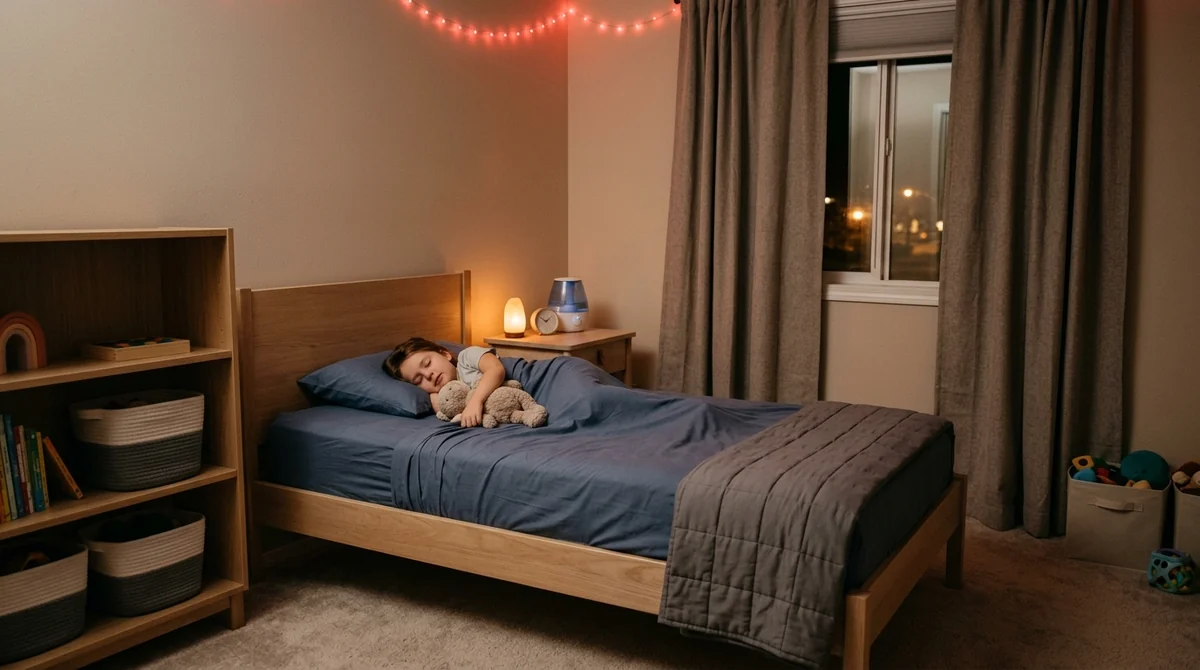
Room Temperature and Microclimate Control
- Target Metric: 65°F to 68°F (18°C to 20°C).
- The Clinical Mechanism: Autonomic nervous system dysregulation frequently impairs peripheral thermoregulation in neurodivergent children. Overheating, even by two degrees, triggers nocturnal micro-awakenings and micro-sweats that disrupt REM cycles.
- Environmental Adjustments: Install a dedicated digital thermometer to track autism bedroom temperature. Dress your child in breathable natural fibers (bamboo or organic lightweight cotton) and choose moisture-wicking mattress protectors.
Tactile Triggers: Compression Sheets vs. Weighted Blankets
- Pajama Fabric Selection: Seams and tags are acute sensory stressors. Switch to tagless sleepwear crafted with flatlock stitching. A simple, immediate workaround: turn standard soft cotton shirts and pajamas inside-out to eliminate seam friction against sensitive skin.
- The Truth About Weighted Blankets: Weighted blankets have become popular for deep touch pressure (DTP). However, clinical observations reveal that many AuDHD kids ultimately reject them. Weighted glass or poly pellets trap radiant body heat, causing nighttime sweating, and their sheer heft can restrict restless legs during subconscious movements.
- The Superior Solution (Lycra Compression Sheets): When comparing compression sheets vs weighted blankets, breathable Lycra/spandex bed sheets often prove far superior. These sheets fit snugly over the mattress like an elastic tube, providing constant, distributed proprioceptive hug pressure without trapping thermal heat or restricting leg movement.
Auditory and Visual Dampening
- Brown Noise vs. White Noise: Traditional white noise contains high-frequency energy resembling radio static or a hissing faucet, which can irritate sound-sensitive (hyperacusic) autistic children. Brown noise, by contrast, concentrates acoustic energy in deeper, lower frequencies—mirroring the gentle rumble of distant thunder, heavy rain, or a low waterfall. This effectively masks sudden household thuds without aggravating auditory defensiveness.
- Red-Spectrum Illumination: Eliminate all blue- and green-wavelength light sources 90 minutes before bedtime. Replace bedside lamps with amber or red-spectrum LED nightlights (wavelengths above 620 nm), which provide visual reassurance in the dark without suppressing endogenous melatonin secretion in the pineal gland.
Step 2: The Dual-Track Bedtime Routine (Dopamine + Sensory)
The conventional “warm bath and quiet book” script frequently fails neurodivergent kids because it is too passive for ADHD and too unstructured for Autism. Effective autism adhd bedtime routine tips utilize a synchronized, dual-track framework that calms sensory input while progressively tapering dopamine:
DUAL-TRACK BEDTIME ROUTINE MAP:
TRACK A (Dopamine Taper): 60-90m: Heavy Work ──► 30m: Audio Story ──► Lights Out: Tactile Fidget
TRACK B (Sensory Wind-Down): Dim Amber Lights ──► Compression Sheet ──► Low-Hum Brown Noise
The “Dopamine Taper” (Tackling the Screen Transition)
Abruptly turning off tablets or television sets triggers an acute dopamine crash. For an ADHD brain, this abrupt biochemical drop feels physically painful, sparking emotional dysregulation and aggressive protests.
The Bridge Activity Protocol:
- Move from Active to Passive Media: Do not jump straight from fast-paced video games to dead silence. Transition the child first to passive audio content—such as a familiar audiobook, a gentle children’s bedtime meditation, or an educational science podcast played at 1.0x speed.
- Low-Demand Hand Engagement: While listening to audio, allow their hands to remain engaged with low-demand, quiet tactile toys: kinetic sand, soft therapy putty, or sorting familiar building bricks under dim amber lighting. This satisfies dopamine cravings while letting the visual cortex power down.
Pre-Bed Heavy Work (Proprioceptive Input)
Proprioception—the body’s internal sense of joint position and muscular effort—acts as a natural neurological calming mechanism. Engaging in targeted proprioceptive input before bed stimulates joint mechanoreceptors, facilitating serotonin release and reducing central nervous system arousal without spiking the cardiovascular system.
Try these calming heavy-work exercises 45 minutes before lights-out:
- Hallway Animal Walks: Challenge your child to a slow “bear crawl” (palms and feet flat) or “crab walk” down the hallway.
- Wall Push-Ups: Have the child place their hands against the wall and perform 10–15 slow, steady presses.
- The “Taco Roll” or Pillow Squish: Gently roll your child up in a soft blanket or provide firm, rhythmic downward pressure with an oversized sofa cushion across their legs and torso (always keeping the face completely clear).
For additional co-regulation tools to keep yourself grounded during bedtime resistance, explore our guide on The Calm Anchor emotional regulation techniques for parents.
Visual Routines to Eliminate Demand Avoidance
Repetitive verbal commands (“Put on your pajamas! Brush your teeth! Get in bed!”) easily trigger Pathological Demand Avoidance (PDA) in an exhausted child. Verbal commands require cognitive processing power that is already depleted by evening.
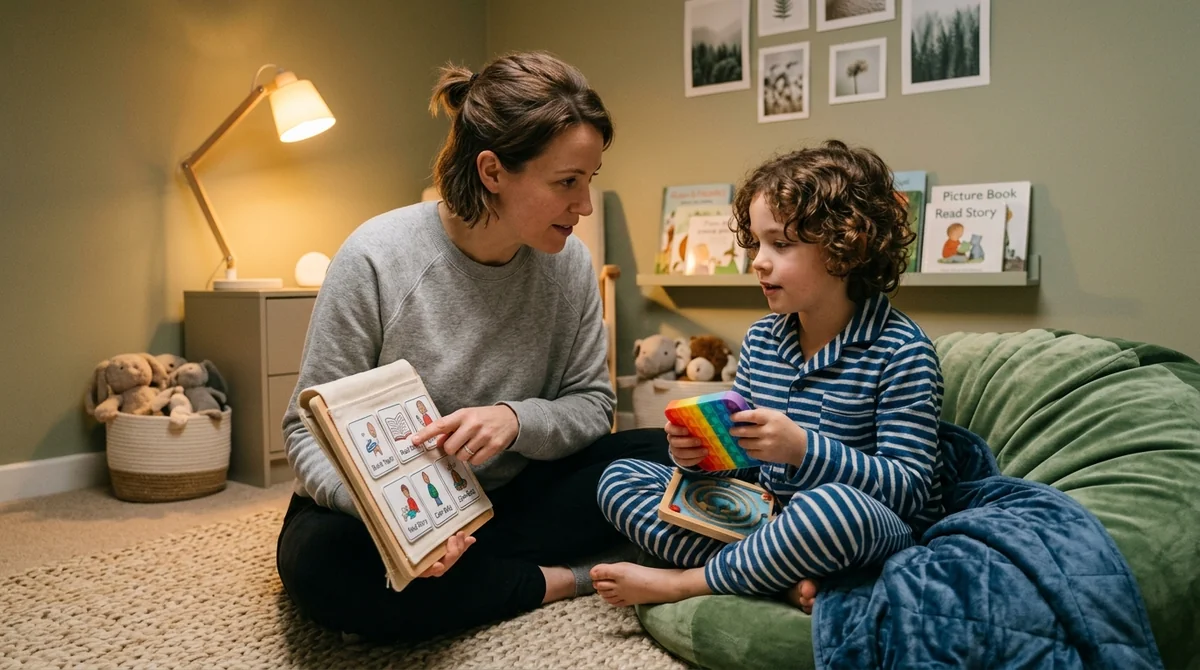
- Non-Verbal Cues: Replace verbal reminders with physical visual schedules, flip-cards, or magnetic token checklists.
- Tangible Time: Use an analog visual countdown clock (like a Time Timer) where a colored disk shrinks as time elapses. This makes the concept of bedtime visually concrete rather than an arbitrary adult demand.
Step 3: The 14-Night “Stimulus Fading” Schedule for Independent Sleep
Many parents find themselves trapped co-sleeping out of pure survival. If your child cannot fall asleep without a parent lying beside them, attempting cold-turkey separation will trigger acute panic. Instead, implement stimulus fading sleep training—a clinically validated behavioral method that gradually desensitizes transition anxiety.
The Independent Sleep Transition Plan
The following day-by-day protocol allows parents seeking how to stop co-sleeping with autistic child profiles to gradually fade their physical presence while maintaining psychological safety:
| Phase | Timeline | Parent Location | Physical Interaction | Verbal Script / Parental Behavior |
|---|---|---|---|---|
| Phase 1 | Days 1–3 | Sitting on the edge of the child’s bed | Continuous gentle hand on shoulder or back | “Your body is safe and resting. It is time for sleep.” Whisper once, then remain completely silent. |
| Phase 2 | Days 4–7 | Sitting on a chair positioned directly beside the bed | No physical touching; close proximity only | Neutral reassurance if child becomes agitated. Avoid direct eye contact. |
| Phase 3 | Days 8–10 | Chair moved halfway between bed and bedroom doorway | None | Silent calming presence. Do not engage in bedtime debate or answer stall questions. |
| Phase 4 | Days 11–13 | Chair positioned directly inside the open doorway | None | Face toward hallway. The child can clearly see your comforting silhouette. |
| Phase 5 | Day 14+ | Outside the bedroom doorway with scheduled check-ins | None | Brief check-ins: step to door at 5 min, then 10 min, then 15 min. “You are safe. Goodnight.” |
Handling Stall Tactics with the “Bedtime Pass” Strategy
AuDHD children excel at stalling tactics: “I need another sip of water,” “My socks feel weird,” “I forgot to tell you something important.” These are dopamine-seeking and anxiety-avoidance maneuvers.
- Provide Two Physical Passes: Give your child two laminated cards every evening at lights-out.
- The Ground Rules: Each pass can be exchanged for one legitimate request—one hug, one small sip of water, or one specific question. Once surrendered, the pass is gone for the night.
- Autonomy & Predictability: This strategy grants the child autonomy and a safety valve for anxiety, while maintaining clear, non-negotiable boundaries. If managing daily caregiving routines has left your own reserves drained, our resource on autistic burnout recovery and daily sensory energy offers practical strategies to rebuild parental resilience.
Step 4: Medical Interventions, Stimulant Rebound, and Supplements
When behavioral and sensory interventions are in place, medical and biochemical factors must be reviewed in close partnership with your healthcare provider.
Managing ADHD Stimulant Rebound
Children taking central nervous system stimulants (such as methylphenidate or mixed amphetamine salts) often encounter an acute phenomenon known as adhd stimulant rebound bedtime. As daytime medication clears the bloodstream in the late afternoon or early evening, dopamine levels drop steeply below baseline.
This sudden withdrawal leads to:
- Marked motor agitation and physical restlessness.
- Rebound irritability, emotional volatility, and tearfulness.
- Rapidly racing thoughts that prevent sleep onset.
Pediatric Discussion Points:
- Dosing Schedule Adjustments: Discuss adjusting the administration time of morning extended-release capsules with your prescriber.
- Late-Afternoon Micro-Doses: In select cases, pediatricians prescribe a very small, short-acting dose in late afternoon to smooth the downward slope of medication clearance.
- Evening Alpha-2 Adrenergic Agonists: Non-stimulant medications such as Clonidine or Guanfacine (guanfacine for sleep in adhd) are frequently prescribed off-label for evening administration. These agents reduce central sympathetic outflow, lowering noradrenaline levels, decreasing blood pressure, and enabling the nervous system to relax.
Melatonin Therapy: Safe Protocols for Neurodivergent Kids
Peer-reviewed clinical evidence published by the National Institute of Mental Health (NIMH) on Autism Spectrum Disorder highlights that neurodivergent individuals frequently experience atypical circadian rhythms and delayed endogenous melatonin secretion.
MELATONIN BEST PRACTICES:
• TIMING: Administer 30 to 60 minutes BEFORE target sleep window (not at lights out).
• DOSAGE: Start at micro-doses (0.5 mg to 1.0 mg); avoid mega-doses (>5 mg).
• FORMULA: Immediate-Release for Sleep Onset; Extended-Release for Night Maintenance.
Authoritative clinical updates from the National Institute of Mental Health (NIMH) on ADHD similarly identify delayed sleep phase syndrome as a common comorbidity.
When discussing melatonin dosage autistic child strategies with your physician, adhere to three core principles:
- Timing Matters More Than Dose: Melatonin is a circadian phase-shifter, not an anesthetic knock-out drug. Give it 30 to 60 minutes prior to sleep onset to mirror natural biological signaling.
- Start Low: Begin with 0.5 mg to 1 mg. High commercial doses (5 mg to 10 mg) often cause morning grogginess, vivid nightmares, and receptor desensitization.
- Select the Right Formulation: Use immediate-release liquids or tablets for sleep-onset delay. Use prolonged-release micro-pellets if your child’s primary struggle is waking up repeatedly throughout the night.
Ruling Out Underlying Physiological Sleep Disorders
Before assuming all sleep resistance is behavioral or sensory, screen for underlying physiological sleep pathologies:
- Obstructive Sleep Apnea (OSA): Look for mouth breathing, audible snoring, frequent tossing, or morning headaches. Pediatric OSA warrants an evaluation by an Ear, Nose, and Throat (ENT) specialist for enlarged tonsils or adenoids.
- Restless Legs Syndrome (RLS) & Iron Stores: Restless, jerking limbs or complaints of “bugs crawling in my legs” may indicate pediatric RLS. Have your pediatrician evaluate serum ferritin levels; neurodivergent children often require ferritin levels above 50 ng/mL to prevent evening motor restlessness.
Step 5: Troubleshooting Night Wakings (“The 2:00 AM Party”)
One of the most exhausting challenges for parents is the midnight waking—when an autistic child wakes up middle of night energized and ready to play at 2:00 AM. In neurodivergent literature, this phenomenon is often referred to as “the 2:00 AM party.”
De-escalating the Midnight Awakening
When sleep cycles decouple, children may experience sudden cortical wakefulness without daytime fatigue. How caregivers respond determines whether this waking becomes a permanent circadian anchor.
Follow this clinical protocol during audhd night wakings:
- Preserve Darkness: Keep illumination strictly dark or use ultra-dim amber lighting. Never turn on overhead lights, as photic input immediately halts pineal melatonin production.
- Neutral, Robotic Responses: Do not engage in animated conversation, emotional scolding, or problem-solving. Maintain a warm but flat, predictable tone: “It is nighttime. Your room is safe. Bodies stay in bed.”
- The “Boredom Box” Strategy: If your child is wide awake and unable to fall back asleep immediately, do not allow screens or high-stimulation toys. Instead, place a designated “Boredom Box” near the bed containing low-stimulation tactile items:
- Silicone pop-its.
- Soft picture books or graphic novels.
- Gentle fidget mazes or textured fabric swatches.
- Independent Reassurance: Allow the child to quietly explore the box in bed until drowsiness returns. As affirmed in clinical parenting research published by the American Psychological Association (APA) on parental consistency, predictable caregiver responses and calm emotional boundaries provide the psychological safety children need to gradually develop internal self-regulation.
Frequently Asked Questions About AuDHD Sleep
Do autistic children with ADHD need less sleep than neurotypical kids?
No, children with both Autism and ADHD do not need less sleep than their neurotypical peers. Their neurobiology makes initiating and maintaining sleep significantly more difficult due to dopamine regulation differences and sensory hypersensitivities. Chronic sleep deprivation amplifies daytime executive dysfunction, emotional volatility, and sensory meltdowns, making consistent restorative sleep essential.
Why does my child get hyperactive right before bedtime?
Pre-bedtime hyperactivity is a hallmark sign of overtiredness and dopamine craving. When an ADHD child’s brain is exhausted, the prefrontal cortex loses inhibitory control. To stave off sleepiness, the autonomic nervous system releases an emergency surge of cortisol and adrenaline, resulting in sudden bursts of running, silliness, and resistance.
What is better for an AuDHD child: a weighted blanket or a compression sheet?
Compression bed sheets made of stretchy Lycra/spandex are generally better tolerated by AuDHD children than weighted blankets. While weighted blankets provide calming deep touch pressure, they frequently trap excessive body heat and restrict movement. Compression sheets provide identical soothing proprioceptive feedback while remaining cool, breathable, and flexible.
Can screen time be used safely before bed for an autistic child?
Interactive screen time (such as video games, tablet apps, or fast-paced short videos) should be strictly avoided within 90 minutes of bedtime due to dopamine surges and blue-light emission. However, passive audio media—such as low-stimulation audiobooks, bedtime stories, or ambient brown noise—can be safely used to soothe an under-stimulated ADHD brain in the dark.
Conclusion & Next Steps for Exhausted Families
Navigating sleep with an autistic and ADHD child is an intense, non-linear journey. There will be nights where routines flow effortlessly, followed by weeks disrupted by developmental leaps, illness, or sensory regressions.
Give yourself grace. Progress is not measured by sudden eight-hour stretches of uninterrupted slumber; it is measured in small, cumulative 15-minute victories. Embracing your child’s unique developmental timeline—as explored in our reflections on radical acceptance in parenting neurodivergent children—frees you from the trap of unrealistic expectations and restores peace to your family dynamic.
Action Checklist for Tonight
- Audit the Bedroom: Lower the thermostat to 66°F, inspect pajamas for irritating seams, and switch from white noise to brown noise.
- Establish the Dopamine Bridge: Replace tablet gaming 60 minutes before bed with a calming audiobook and soft sensory putty.
- Introduce Heavy Work: Spend 5 minutes before tooth brushing on slow bear crawls or gentle cushion squishes.
- Partner with Your Doctor: Keep a 7-day sleep log documenting sleep onset times, awakenings, and medication hours to review with your pediatrician.
Clinical References & Peer-Reviewed Evidence
- National Institute of Mental Health (NIMH). (2024). Autism Spectrum Disorder: Information and Neurodevelopmental Research. U.S. Department of Health and Human Services. Accessible via NIMH.nih.gov.
- National Institute of Mental Health (NIMH). (2024). Attention-Deficit/Hyperactivity Disorder: Executive Functioning and Neural Regulation. U.S. Department of Health and Human Services. Available at NIMH.nih.gov.
- American Psychological Association (APA). (2023). Parenting Practices and Emotional Regulation in Developing Children. Available at APA.org.
- American Academy of Pediatrics (AAP). (2022). Clinical Practice Guideline: Evaluation and Management of Pediatric Insomnia in Children with Neurodevelopmental Disorders. Pediatrics, 149(3), e2021055923.
- Journal of Autism and Developmental Disorders. (2021). Melatonin Biosynthesis and Circadian Gene Expression Profiles in Children on the Autism Spectrum. JADD, 51(8), 2841–2853.
- Journal of Child Neurology. (2020). Sleep Architecture and Dopaminergic Tone in Pediatric Attention-Deficit/Hyperactivity Disorder. JCN, 35(6), 412–420.
- Sleep Medicine Reviews. (2022). Proprioceptive Interventions, Deep Pressure Touch, and Sensory Accommodations in Pediatric Sleep Disturbance: A Systematic Review. Sleep Med Rev, 62, 101594.
- Child Mind Institute. (2023). Managing Evening Medication Rebound and Sleep Disruption in Pediatric ADHD. Clinical Practice Resources.