
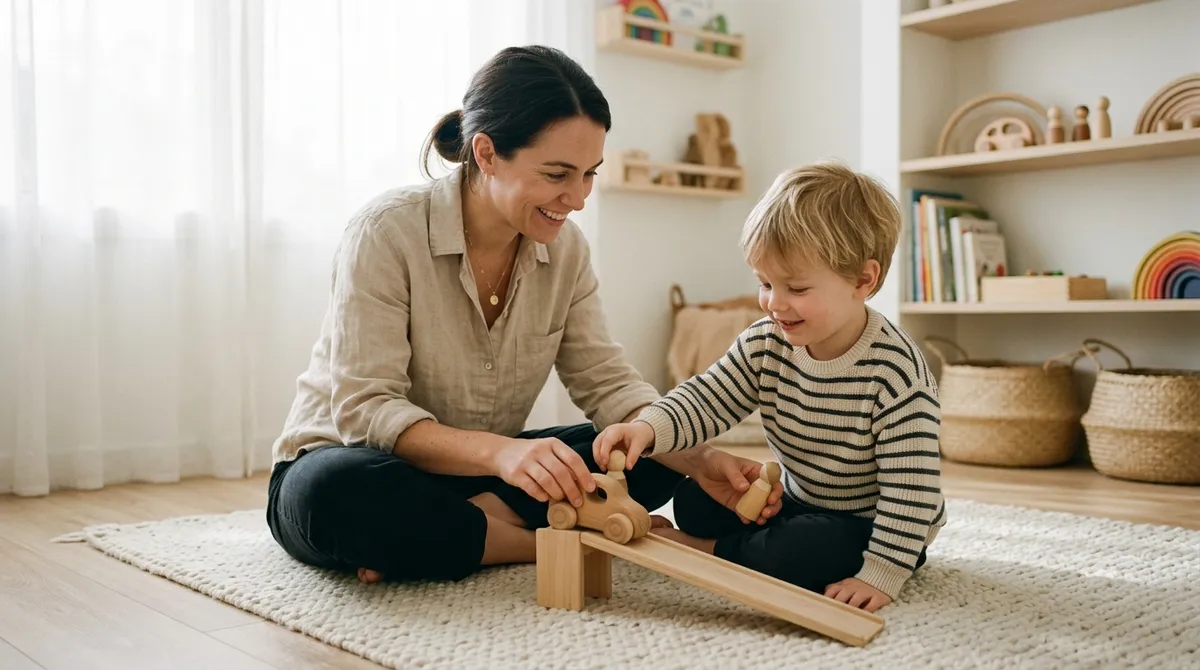
By Med Ka | Reviewed by the Med Ka Editorial Team · Published: October 2026
Quick-Summary: Key Takeaways
- Reimagining Symbolic Play: Play is never a compliance exercise or a standardized test. For autistic children, pretend play is an avenue for sensory discovery, emotional co-regulation, flexible cognition, and authentic connection.
- Neurodiversity-Affirming Foundations: Lining up toys, scripting favorite dialogue, and parallel play are meaningful developmental baselines, not deficits that need correction.
- The 5-Step Teaching Framework: Use the gentle cycle of Observe, Join, Model, Pause, and Expand to follow your child’s intrinsic passions without imposing rigid demands.
- Multimodal Inclusion: Spoken words are not a prerequisite for imagination. Robust visual supports, First-Then schedules, and Augmentative and Alternative Communication (AAC) empower nonspeaking children to fully share their worlds.
Learning how to teach pretend play to an autistic child starts with fundamentally reimagining what play looks like and why it matters. For neurodivergent children, play is not a test of compliance—it is an authentic pathway to sensory regulation, cognitive flexibility, and joyful social connection.
When parents, educators, and speech-language pathologists (SLPs) search for strategies on how to teach pretend play to an autistic child, they often encounter rigid developmental checklists that compare neurodivergent children against neurotypical milestones. If a child prefers lining up miniature trains, spinning the wheels of an inverted toy truck, or repeating the exact dialogue from an animated film, traditional clinical models have historically labeled these behaviors as restricted, repetitive, or atypical.
However, modern neurodevelopmental science and neurodiversity-affirming practices show that play is not a performance test. When we shift away from forcing compliance and instead honor a child’s natural interests, learning how to foster symbolic thinking transforms from a high-pressure intervention into an inviting, collaborative journey.
1. Reimagining Play for Autistic Children
Defining Pretend and Symbolic Play
In developmental psychology and speech-language pathology, pretend play occurs when a child uses an object, an action, or an abstract idea to represent a scenario that is not literally happening in that moment.
Pretend play encompasses a wide spectrum of creative behaviors:
- Object Substitution: Using one physical item to stand in for another—such as holding a wooden block to the ear as a smartphone, shaping play dough into a birthday cupcake, or pretending a cardboard box is a spaceship, bus, or submarine.
- Assigning Lifelike Qualities: Treating inanimate toys as though they possess feelings, needs, or agency. This includes tucking a teddy bear under a blanket for bedtime, acting as though a figurine feels tired, or gently offering a toy spoon to feed a doll.
- Role-Playing and Event Reenactment: Acting out familiar daily living routines or imagined narratives, such as cooking pretend soup, taking a toy vehicle to a mechanic for repair, or reenacting a visit to the dentist.
While developmental research on pretend play in autism archived by the National Institutes of Health (NIH / PMC) highlights that autistic children often experience differences in spontaneous symbolic play, their underlying capacity for imaginative pretense readily flourishes when adults provide clear models, structured opportunities, and visual supports. An autistic child may fully comprehend a pretend concept even if they do not spontaneously initiate it on command.
Reframing Autistic Play Preferences
When exploring how to teach pretend play to an autistic child, our first commitment must be neurodiversity-affirming validation. Autistic children do not need to mimic neurotypical play patterns for their engagement to hold deep meaning and developmental value. What often looks different on the surface is actually a foundational starting point, not a deficit that needs fixing:
- Arranging and Lining Up Objects: Organizing toys into precise rows, color gradients, or geometric patterns before starting a story helps organize visual input, establishes predictability, and creates a sense of cognitive order.
- Repeating Favorite Storylines (Scripting): Recreating a favorite television scene, audiobook sequence, or cartoon dialogue in exact chronological order counts as imaginative play. Repetition helps the child process narrative structure, enjoy familiar emotional arcs, and feel secure before experimenting with new plot twists.
- Parallel Play: Playing quietly beside a parent, caregiver, or peer without direct conversation or shared control is a valid, meaningful form of social engagement. Parallel play lowers the overwhelming social demands of constant negotiation while still fostering comfort, observation, and shared space.
- Focusing on Special Interests: Building play scenarios around a deep passion—whether subway systems, dinosaurs, marine biology, or mechanical gears—provides a powerful, motivating bridge into flexible thinking and shared imagination.
[!NOTE] Core Clinical Insight: The goal of play intervention is never to strip away a child’s preferred toys or repetitive routines. Instead, parents and educators should use these authentic preferences as the foundation for building communication, creativity, and problem-solving skills.
Clarifying the Evidence: Myth-Busting Language Acquisition Claims
A frequently repeated claim in early intervention circles suggests that mastering pretend play guarantees an automatic 50% boost in language acquisition. Current developmental research reviews clarify that there is not enough empirical evidence to support using this exact 50% metric as a universal rule.
A more accurate, evidence-based conclusion is that symbolic play and language development are closely related because both rely on symbolic thinking—using one thing (a symbol, word, or block) to represent something else. However, each child’s linguistic progress depends on a complex web of individual motor, sensory, cognitive, and communicative factors. We nurture pretend play not to chase an arbitrary percentage, but because play provides natural opportunities to practice communication, flexible thinking, and shared joy.
2. The Developmental Roadmap: From Exploration to Symbolic Play
To effectively tailor our support, caregivers need a clear understanding of the developmental progression of play. Play is a continuum where each stage builds upon the sensory, motor, and cognitive foundations of the previous one.
An autistic child may demonstrate advanced symbolic storytelling around a favorite topic while simultaneously enjoying exploratory or repetitive sensory play with unfamiliar toys. Understanding functional vs. pretend play helps you meet your child at their exact moment-to-moment comfort level. Functional play involves using an object for its conventional purpose, while pretend play adds an imagined meaning, role, or situation.
Stage 1: Exploratory Play
Exploratory play focuses on how an object looks, feels, sounds, or moves. During this stage, children investigate objects through direct sensory manipulation.
- What It Looks Like: Squeezing a squishy sensory ball, exploring the texture of crinkly fabrics, shaking or banging wooden blocks together, spinning the wheels of an inverted car, or mouthing, dumping, and sorting items.
Stage 2: One-Step Functional Play
In one-step functional play, children engage in single cause-and-effect actions, using toys or objects in the way they were designed to be used.
- What It Looks Like: Pressing a button to make a toy light up, rolling a toy car across the rug, or placing miniature people inside a toy school bus.
Stage 3: Two-Step Functional Play
In two-step functional play, the child makes a significant cognitive leap by connecting two related, sequential actions into a single coherent routine.
- What It Looks Like: Placing a ball on top of a spiral ramp and pressing a lever to release it, or driving a toy car across the carpet and parking it inside a wooden garage.
Stage 4: The Hanen Centre Pretend Play Progression
As children transition out of basic functional play, clinical frameworks established by The Hanen Centre break pretend play down into three distinct developmental sub-stages:
- Multi-Action Functional Stage: The child combines multiple expected play actions together in a clear sequence. For example, a child may place a toy car at the top of a ramp, send it down, pick up the car, roll it through a car wash, and return it to the starting point.
- Early Pretend Play: The child begins mimicking familiar daily living routines using realistic miniature toys. They might engage in activities like pretending to feed a teddy bear with a plastic spoon and bowl or taking a pretend sip from an empty cup.
- Later Symbolic Play: The child ascends to a higher level of imaginative play where they no longer need realistic objects to represent things. They substitute abstract objects—such as using play dough to mold an airplane or holding a rectangular wooden block as a telephone—and start to pretend with imaginary, invisible items.
Visual Reference Table: The Play Continuum
| Stage | Clinical Definition | Real-World Example | Affirming Next Step |
|---|---|---|---|
| Exploratory | Sensory learning through movement, texture, sound, or visual inspection. | Spinning the wheel of an inverted toy truck. | Mirror the action on another truck; add a gentle engine sound. |
| One-Step Functional | Using an object for its conventional cause-and-effect purpose. | Rolling a toy car across the living room rug. | Introduce a toy garage, bridge, or passenger figure. |
| Two-Step Functional | Connecting two sequential, related actions into one routine. | Driving a toy car and parking it inside a garage. | Introduce a simple pretend problem (e.g., “Oh no, out of gas!”). |
| Early Pretend | Mimicking everyday human routines using realistic miniature toys. | Feeding a stuffed puppy with a toy spoon and bowl. | Offer a small cup or wipe the puppy’s face with a napkin. |
| Later Symbolic | Substituting abstract objects or pretending with invisible props. | Holding a plain wooden block to the ear as a phone. | Model a brief pretend phone conversation with a familiar character. |
3. The 5-Step Teaching Framework: “Observe, Join, Model, Pause, Expand”
When figuring out how to teach pretend play to an autistic child, the most critical principle is to avoid turning playtime into a high-pressure test of compliance. Forcing a child to play “the right way” often triggers anxiety and prompt dependency.
Instead of directing every move, parents, therapists, and educators can utilize the Observe, Join, Model, Pause, Expand methodology. Rooted in developmental behavioral approaches described by the Centers for Disease Control and Prevention (CDC), this gentle 5-step framework follows the child’s natural interests and embeds playful learning into organic interactions:
- Observe: Step back and silently observe. Notice which objects, physical motions, auditory sounds, and visual routines naturally hold the child’s attention. Are they lining up animals by size? Examining wheels? Sorting colors?
- Join: Enter their world before inviting them into yours. Copy the child’s action or play quietly alongside them without taking control, giving directions, or redirecting their focus. If the child is repeatedly spinning the wheels of a toy truck, take a second truck and gently spin its wheels beside them. This validates their focus and builds shared attention.
- Model: Demonstrate one small, simple new action closely connected to what the child is already doing. After joining their spinning activity, you might roll your truck forward two inches toward a small block and make a soft “beep beep” sound.
- Pause: Give the child plenty of time to process. Many neurodivergent children require 10 to 15 seconds of cognitive processing time. Resist the urge to repeat the demonstration immediately or ask “Can you do it?” Look for any response—a glance, a smile, a vocalization, a movement, or reaching for an object.
- Expand: When the child remains comfortable and engaged, add one gentle new dimension—a new object, a minor plot twist, or a simple choice. If they roll their truck, place a tiny passenger inside. Keep expansions small, gradual, and pressure-free.
4. Eight At-Home Pretend Play Activities Mapped to Developmental Goals
These structured activities transform everyday household items and familiar routines into engaging learning opportunities:
- Feed a Stuffed Animal: Practice imitation, requesting, and caregiving sequencing. Offer one spoon and two pretend food options (e.g., apple slice vs. carrot), allowing the child to choose using pointing, spoken words, or an AAC device.
- Toy Car Repair Shop: Foster flexible problem-solving and cause-and-effect reasoning. Pretend to fix a “flat tire” on the child’s favorite toy vehicle using a plastic wrench or a wooden pencil as a tool.
- Pretend Grocery Store: Practice requesting, choosing, and turn-taking. Set up two or three preferred pantry items. Use simple picture cards as a shopping list, allowing the child to drop items into a small basket.
- Restaurant / Café Game: Build functional communication and social sequencing. Create a visual picture menu with two favorite snack choices, letting the child take your order or serve you a pretend treat.
- Doll or Plush Bedtime Routine: Rehearse sequencing and daily living habits. Mirror the child’s actual bedtime routine: brush the doll’s teeth, sing a short lullaby, and cover them with a small washcloth blanket.
- Doctor or Dentist Checkup: Desensitize upcoming medical appointments and rehearse body awareness. Listen to a stuffed animal’s heartbeat with a toy stethoscope, carefully removing any loud sounds or bright lights that might cause sensory aversion.
- Puppet Show Dialogue: Practice emotional recognition and perspective-taking. Reenact one short, familiar conversation or humorous routine using soft sock puppets, letting the child control the pace.
- Special-Interest Adventure: Harness deep passions as a bridge into imaginative worlds. If the child loves subway trains or space rockets, build a cardboard station or countdown pad and reenact a launch sequence together.
5. Environmental & Routine Support: Anchoring Play in Daily Life
Imaginative play requires cognitive bandwidth and emotional security. When a child’s nervous system is overwhelmed by unexpected transitions or sensory clutter, their capacity for creative play disappears. Grounding play within a predictable routine and a supportive environment creates the safety needed for imagination to thrive.
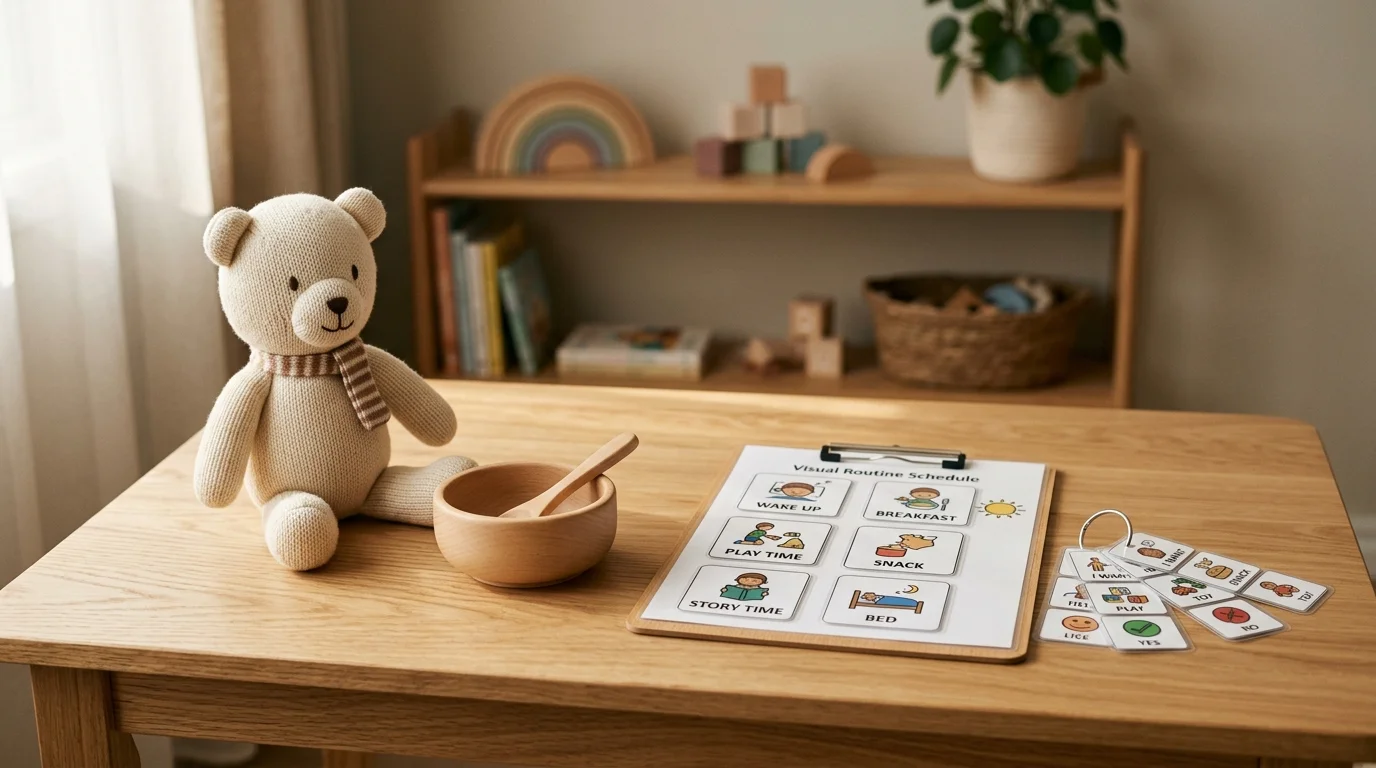 Figure: Integrating visual daily schedules, First-Then boards, and AAC communication aids creates a predictable, low-demand environment where imaginative play can safely unfold.
Segmenting the Day
Break down the daily rhythm into predictable, comforting segments:
- Morning: Wake up, use the bathroom, get dressed, eat breakfast, and prepare for school.
- Afternoon: Enjoy a sensory-friendly snack, engage in calm movement or outdoor play, complete an activity, and eat dinner.
- Evening: Take a warm bath, enjoy quiet storytime or sensory winding down, and turn out the lights.
Visual Supports: Making Expectations Tangible
For many autistic children, spoken directions can fade quickly or feel overwhelming during transitions. Visual supports provide lasting clarity:
- Picture Schedules: Laminated photo or icon strips showing each activity in sequence.
- Visual Timers: Clocks with disappearing colored discs that show time passing visually rather than numerically.
- First-Then Boards: Simple two-step visual boards showing what needs to happen now and what enjoyable activity follows (e.g., “First clean up blocks, Then bubble play”).
- Visual Play Choice Boards: A display of 2 to 4 photo choices showing available play activities, preventing choice overload.
Balanced Flexibility
Maintain consistent anchors for meals and bedtime, but offer your child meaningful choices within those routines. For instance, allow them to choose between two preferred bedtime stories or decide whether their cars sleep in the red box or the blue box.
Sensory Regulation & Calm Corners
Sensory overload is one of the most common barriers to relaxed engagement. As detailed in our guide on how parents of autistic kids handle sensory overload, an overstimulated nervous system cannot access higher-order symbolic thought.
Ensure your play space includes access to a designated calm corner equipped with soothing sensory tools—such as noise-canceling headphones, a weighted lap pad, soft floor pillows, and dimmable lighting—so your child can regulate whenever they feel overwhelmed.
6. Inclusivity & Adaptations: Communication & Sensory Safety
Multimodal Communication & AAC
Play does not require spoken language. Implementing neurodiversity-affirming adaptations ensures nonspeaking and minimally speaking children can participate fully and joyfully.
Children can communicate rich pretend scenarios using gestures, facial expressions, pointing, American Sign Language (ASL), low-tech communication boards, and speech-generating AAC devices recognized by the American Speech-Language-Hearing Association (ASHA).
As we explore extensively in our practical guide on how to use AAC with your child at home, communication devices belong right in the middle of playtime—not locked away on a high shelf. A child who presses the button for “fast” while pushing a train, or points to “sleep” while covering a doll, is actively participating in high-level symbolic play.
Model AAC Without Expectation: “Inspire, Don’t Require”
When introducing communication tools during pretend play, adopt an “inspire, don’t require” mindset:
- Touch communication symbols and speak the words naturally while you play, without demanding that your child press the button before they get the toy.
- If a toy car crashes, tap the icon for “uh-oh” or “stop” on their device and smile.
- By modeling without demanding compliance, you show that communication is a tool for connection, not an admission ticket for play.
Sensory Safety Precautions & Hazard Warnings
Sensory-friendly pretend play reduces unnecessary auditory noise, harsh lighting, chaotic clutter, and tactile discomfort:
- Control Environmental Overload: Limit the number of toys visible at one time to prevent visual overwhelm. Use open storage bins with clear picture labels.
- Crucial Hazard Warning on Water Beads: While popular in sensory bins, water beads pose severe medical ingestion and obstruction risks for young children and must not be used. Instead, create safe, tactile sensory bins using dry rotini pasta, large craft pom-poms, smooth river stones, fabric scraps, or edible sensory bases (such as crushed oat cereal) selected with choking and allergy safety in mind.
7. Troubleshooting Guide: What to Do When Play Stalls
When a child walks away from an activity, repeats the same motion continuously, or becomes upset, they are communicating valuable information. The task may be too complex, sensory demands may be too high, or the scenario may feel unpredictable.
| Observable Behavior | What It Usually Communicates | Neurodiversity-Affirming Strategy |
|---|---|---|
| Child walks away immediately | The activity feels too long, overly demanding, or uninteresting. | Shorten the interaction to 30 seconds; incorporate their absolute favorite special interest. |
| Child continuously repeats one action | The repetitive action provides soothing sensory regulation or predictability. | Join the rhythm first; mirror their action before introducing one subtle variation. |
| Child does not imitate your model | The modeled step was too fast, complex, or linguistically heavy. | Simplify to a single physical action (e.g., dropping a block) with zero verbal demands. |
| Child changes the story direction | The child is expressing authentic creative autonomy and agency. | Enthusiastically follow their lead; validate their unique narrative twist. |
| Child becomes agitated or distressed | Sensory, motor, or social demands have exceeded their current bandwidth. | Stop all demands immediately; step back and assist with sensory co-regulation. |
| Child ignores formal toys entirely | Commercial toys may lack sensory feedback or personal meaning. | Offer household items (cardboard boxes, kitchen spoons, measuring cups, cushions). |
When play leads to sudden emotional distress, it is crucial for caregivers to understand whether the child is experiencing a behavioral boundary struggle or a neurological crisis, as detailed in our clinical comparison between an autism meltdown vs. a temper tantrum.
[!TIP] Free Caregiver Emergency Tool: When play transitions or unexpected sensory changes trigger overwhelming emotional distress, having an immediate, calm action plan is essential. Keep a printed copy of our Meltdown First Aid Checklist: Step-by-Step Actions for Caregivers accessible at home or in your therapy toolkit to support safe, compassionate de-escalation and co-regulation.
8. Frequently Asked Questions (FAQ)
How do autistic children engage in pretend play?
Autistic children often engage in pretend play through deep special interests, reenacting beloved movie scenes or book narratives (scripting), arranging objects into structured environments, or engaging in parallel play alongside peers. They may express imaginative concepts through spoken language, AAC devices, body movements, or intricate physical positioning of toys rather than conventional dialogue.
Can a nonspeaking autistic child participate in pretend play?
Absolutely. Spoken language is not required for imaginative thinking. Nonspeaking children participate in pretend play by moving figurines, manipulating objects, pointing to picture symbols, using speech-generating AAC apps, making expressive vocal sounds, and using facial expressions. Accepting and honoring all communication modalities creates an inclusive space where creativity can thrive.
Do autistic children prefer parallel play over group play?
Many autistic children prefer parallel play because it allows them to enjoy the comforting presence of another person without the exhausting demands of rapid verbal negotiation, divided attention, and social compromise. Parallel play provides a safe foundation for mutual observation, imitation, and shared comfort without social exhaustion.
Should I stop my child from repeating the same play routine?
No. Repetitive play routines serve essential neurodevelopmental functions: they provide sensory regulation, emotional security, and a predictable space to process life experiences. Rather than stopping repetitive play, caregivers can gently join the routine, validate the child’s enjoyment, and occasionally model one subtle expansion when the child feels safe and receptive.
How do visual aids support play and daily routines?
Visual aids—including picture schedules, First-Then boards, and visual timers—convert abstract, fleeting spoken words into concrete, lasting visual anchors. They drastically reduce transition anxiety, clarify expectations, and give neurodivergent children the cognitive predictability they need to relax, explore, and immerse themselves in creative play.
By honoring your child’s individual developmental timeline, welcoming all communication modalities, and providing structured, predictable routines, families and educators can cultivate rich, engaging play experiences. Teaching pretend play to an autistic child is ultimately about building a shared world of mutual respect, authentic connection, and joyful imagination.