

Autistic readers often demonstrate exceptional fluency and decoding accuracy from a surprisingly young age, yet they can severely struggle when asked to summarize a narrative. Summarizing requires a reader to move far beyond simply decoding individual sentences; it demands the ability to integrate plot points, identify character motivations, extract the overarching theme, and understand the unwritten social dynamics at play. This comprehensive guide breaks down the cognitive reasons behind this gap—exploring concepts like hyperlexia and weak central coherence—and provides highly structured, evidence-based tools that parents, therapists, and educators can use at home or in the classroom to significantly improve Autism Reading Comprehension: Summarizing Stories.
The Hyper-Decoding Paradox: Reading Words vs. Summarizing Stories
When discussing literacy in neurodivergent children, we often encounter a fascinating but challenging paradox. The mechanics of reading (sounding out words) might be flawless, but the purpose of reading (extracting meaning) remains elusive.
Strong Word Recognition vs. Meaning-Making
- The Hyperlexic Profile: Many autistic children excel at phonics and fluent oral reading. This condition, often referred to as hyperlexia, is characterized by an intense fascination with letters and numbers and an advanced ability to decode language early on. However, this impressive mechanical skill often masks significant underlying comprehension hurdles. Standardized reading tests frequently fail to catch these gaps early in a child’s academic career because early elementary assessments heavily prioritize literal recall—asking “who” or “where”—over holistic understanding and inference.
- The Summarization Breakdown: While non-autistic peers naturally synthesize plot details into a central takeaway or moral lesson, autistic readers often perceive texts as isolated blocks of facts. When addressing hyperlexia vs reading comprehension autism, it is crucial to recognize that reading the words perfectly does not guarantee understanding the narrative arc. A child might read a chapter book aloud with perfect intonation but be unable to tell you what the chapter was actually about.
Detail-Focused Processing (Weak Central Coherence)
- The “Trees for the Forest” Challenge: Neurocognitive research frequently highlights the concept of Weak Central Coherence in the autistic brain. This is a cognitive style that prioritizes local detail over global synthesis. In everyday terms, it means the child is exceptionally good at seeing the individual trees, but struggles to perceive the forest. This directly impacts weak central coherence reading comprehension.
- Impact on Plot Summaries: When asked to summarize a story, readers with weak central coherence might accurately recall specific sentences, the exact color of a character’s shirt, or minor background details. However, they struggle profoundly to determine which facts matter most to the overall plot. Without explicit instruction, main-idea generation becomes nearly impossible because every detail is assigned the same level of importance. This is why a summary often sounds like a random list of facts rather than a cohesive storyline.
“Understanding a story requires stepping back from the specific words to see the entire landscape of the narrative. We must teach children not just to read the text, but to read between the lines.”
The 3 Major Cognitive Obstacles to Story Summarization
To effectively help an autistic child summarize a story, we must first understand exactly where the breakdown occurs. It is rarely an issue of intelligence; rather, it is a difference in how information is processed and socially interpreted.
1. Theory of Mind and Character Intentions
- Decoding Social Moves: At its core, a story is a sequence of social interactions and emotional reactions. Summarizing stories requires understanding why characters act the way they do—their hidden goals, underlying fears, emotional reactions, and social motives. Autistic readers often face inherent challenges with Theory of Mind, which is the ability to attribute mental states (beliefs, intents, desires, emotions) to oneself and to others, and to understand that others have beliefs and desires that are different from one’s own. Developing theory of mind story comprehension autism strategies helps bridge this critical gap, turning confusing character actions into logical steps.
- Interpreting Non-Literal Language: Characters in books frequently lie, use sarcasm, or hide their true feelings. These social nuances frequently disrupt story tracking unless they are explicitly decoded. If a character says “Oh, great!” when it starts raining, an autistic reader might interpret this literally and assume the character loves the rain, completely missing the frustration that drives the plot forward.
2. Anaphoric Tracking & Cohesive Links
- Lost Connections Across Paragraphs: Summaries fail when a reader loses track of who is doing what. This often happens because the reader cannot connect pronoun references (“she,” “they,” “it,” “those”) back to their original nouns across multiple sentences or paragraphs. This is known as anaphoric resolution. Direct instruction in anaphoric cue reading autism can significantly improve reading flow. For example, if a paragraph reads, “The dog chased the ball. He ran fast. It bounced away,” the child needs to explicitly understand that “He” is the dog and “It” is the ball.
- Missing Textual Glue: Autistic readers frequently miss the “cohesive links” that signal cause-and-effect transitions in a text (words like because, however, as a result, nevertheless). These words are the glue that holds a narrative together. Mastering cohesive links reading comprehension is essential for maintaining the storyline. If a child misses the word “however,” they will completely miss the turning point of the conflict.
3. Figurative Language and Inference Hurdles
- The Literal Interpretation Trap: Idiomatic expressions (e.g., “having a heavy heart,” “spilling the beans,” “a piece of cake”) are often processed entirely literally. A child might spend precious cognitive energy wondering why someone is carrying a heavy physical heart, leading to confusion that derails plot comprehension entirely.
- Predictive Gaps: Abstract, open-ended questions like “What do you think will happen next?” or “Why do you think he did that?” can leave an autistic child’s mind feeling like “a blank page.” Predicting future outcomes requires drawing on past social experiences and applying them to fictional scenarios—a complex cognitive leap that requires significant scaffolding and anchoring in concrete personal experience.
The Step-by-Step Framework: Teaching Autistic Readers to Summarize Stories
If you are a parent or educator wondering how to teach autistic child to summarize a story, the key is to move away from abstract questions and implement structured, visual, and highly concrete methods. The following framework provides a roadmap for success.
Step 1: Anaphoric Cue Tracing & Cohesive Link Mapping
Before a child can summarize a whole story, they must be able to comprehend a single paragraph without losing the thread.
- Explicit Pronoun Linking (The Arrow Method): Do not assume the child knows who “he” or “she” is. Teach readers to physically interact with the text. Have them take a pencil and draw an actual arrow from the pronoun back to the antecedent noun. This makes the invisible linguistic connection visually concrete.
- Cohesion Sentence Building: Instead of reading a whole page and then asking questions, read sentence by sentence. Explicitly discuss how Sentence B connects to Sentence A before moving to Sentence C. Ask, “Did Sentence B happen because of Sentence A, or after Sentence A?” This builds the cause-and-effect muscle necessary for summarization.
Step 2: “Gestalt” Mental Imaging (Visualizing and Verbalizing)
Autistic individuals are often highly visual thinkers. We must leverage this strength to overcome weak central coherence.
- Moving Beyond Details to the Whole: Implement techniques inspired by the Visualizing and Verbalizing (V/V) approach. This guides readers in constructing a “gestalt” (a whole that is more than the sum of its parts) mental picture of the narrative. Using visualizing and verbalizing autism reading techniques helps create a running mental movie of the text, rather than a list of disconnected facts.
- Dual-Channel Processing: After a paragraph, stop and have the child draw their mental image, or describe it aloud using specific structure words (What size? What color? What is the background?). By forcing the child to describe the entire scene, you shift their focus from isolated words to the overarching narrative environment.
Step 3: Emotion & Motivation Anchors (“When” vs. “If” Scaffolding)
To summarize a plot, you must understand the problem. The problem is usually driven by character emotion.
- Character Motivation Charts: Use graphic organizers that visually pair a character’s action directly with their goal and their underlying emotion. Create a chart with columns: “What they did,” “What they wanted,” and “How they felt.”
- Personalized Experience Anchors: Autistic children often struggle with hypothetical empathy but excel at concrete empathy. Shift from hypothetical prompts (“How would you feel IF you lost your dog?”) to concrete experiential anchors (“Remember WHEN you lost your favorite toy at the park? How did you feel then? The character feels exactly like that right now.”). This helps children transfer their own lived, concrete emotions to abstract story characters.
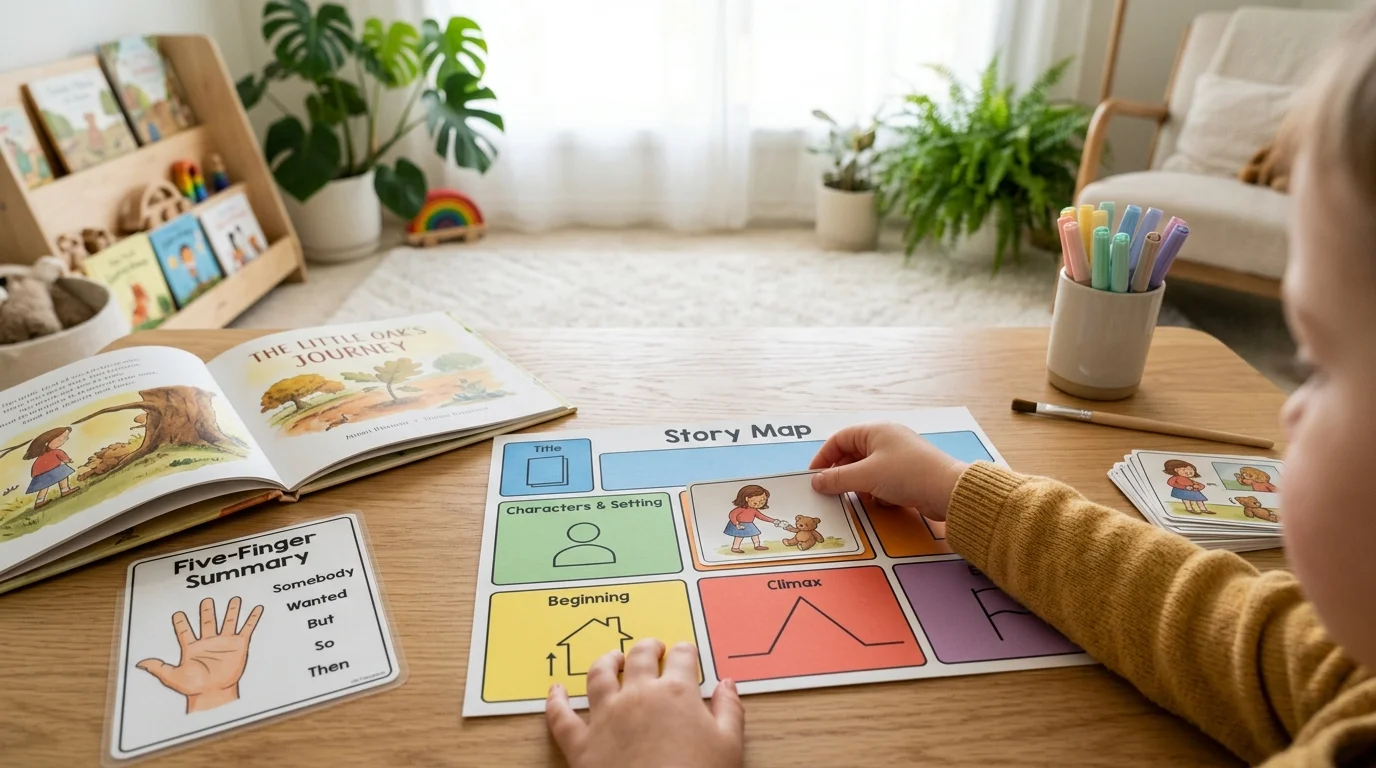
Step 4: The 5-Finger Story Summary Template
When it is time to actually generate the summary, open-ended requests like “Tell me what the book was about” are destined to fail. Implementing graphic organizers for autistic readers is highly effective because it provides a predictable boundary for the task.
Provide a visual, structured summary card that breaks plot synthesis down into 5 concrete prompts, often referred to as the SWBST method. You can have the child trace their hand and write one prompt on each finger:
| Finger | Prompt Focus | The Concrete Question to Ask |
|---|---|---|
| 1. Somebody | Character | Who is the MAIN character? (Pick only one) |
| 2. Wanted | Goal | What was their biggest goal or motivation in the story? |
| 3. But | Obstacle | What was the main obstacle or problem that got in their way? |
| 4. So | Action | What specific action did they take to try and solve the problem? |
| 5. Then | Resolution | How did the story end, and what was the final outcome? |
Example Summary Generation: Instead of: “Cinderella is about a girl and she has a blue dress and a fairy and mice and a pumpkin and she loses a shoe.” The 5-Finger method produces: “Somebody: Cinderella Wanted: to go to the royal ball, But: her evil stepmother locked her away and ruined her dress. So: her fairy godmother used magic to get her to the ball, Then: the prince found her glass slipper and they got married.”
If reading challenges trigger frustration and emotional dysregulation during homework time, having an immediate de-escalation plan is crucial. We highly recommend keeping our Meltdown First Aid Checklist: Step-by-Step Actions for Caregivers accessible for these difficult moments to ensure learning can resume peacefully.
For children who are transitioning from basic reading comprehension to more complex written assignments, our comprehensive guide on How to help an autistic child write a book report provides step-by-step graphic organizers and sensory writing accommodations that build perfectly on these summarizing skills.
Practical Daily Exercises for Parents and Educators
Improving reading comprehension doesn’t only happen during formal reading instruction. It can be integrated into daily life.
- Summarize Movies: After watching a favorite movie or a short cartoon, practice the 5-Finger Summary method. Movies provide a visual scaffolding that makes identifying the plot much easier than text alone.
- The “One Sentence” Challenge: After reading a bedtime story, challenge your child to tell you the entire story using only one sentence. This forces them to identify the absolute core of the narrative, combating the urge to list minor details.
- Picture Sequencing Cards: Before working with text, use picture sequencing cards. Have the child arrange 4-5 pictures in order and explicitly tell you the “story” the pictures show. Emphasize transition words like first, next, then, finally.
- Emotion Charades: Play games where you act out complex emotions (frustration, confusion, relief) without using words. Have the child guess the emotion and explain why you might be feeling that way, building the Theory of Mind skills necessary for literary analysis.
E-E-A-T External Link Strategy & Scientific Context
To support your child effectively and advocate for their needs in an educational setting, it is incredibly helpful to understand the clinical and scientific frameworks behind these autism reading comprehension strategies.
- Neurodevelopmental Profiles and Diagnostics: For official, rigorously vetted frameworks defining neurodevelopmental profiles, cognitive processing styles, and diagnostic criteria, parents and professionals can refer to resources provided by the National Institute of Mental Health (NIMH). Understanding the neurological basis for weak central coherence can shift the focus from behavioral correction to cognitive support.
- Speech and Language Interventions: Reading comprehension is fundamentally a language processing task. When seeking professional help for pragmatic language deficits, inferencing difficulties, and semantic cohesion, the American Speech-Language-Hearing Association (ASHA) provides excellent peer-reviewed resources, practice portals, and directories to find certified Speech-Language Pathologists (SLPs) who specialize in literacy.
- Evaluating Evidence-Based Protocols: Not all reading programs are created equal, and many popular methods are ineffective for neurodivergent learners. Organizations like the Association for Science in Autism Treatment (ASAT) offer comprehensive, scientifically rigorous evaluations of various educational interventions and literacy protocols (such as the Visualizing and Verbalizing framework), ensuring parents are investing time and resources into methods proven to work.
Actionable Parent & Educator Checklist
To ensure these strategies translate into real-world success, keep this quick reference checklist handy during your next reading session:
- Pre-teach figurative phrases: Scan the text beforehand and explicitly explain idioms and metaphors before starting a new story.
- Use visual story maps: Rely on graphic organizers rather than open-ended verbal discussion questions to guide comprehension.
- Trace the pronouns: Have the child physically draw lines connecting pronouns to their antecedents to prevent them from getting lost in the text.
- Anchor summaries in character motivations: Consistently use the “Somebody-Wanted-But-So-Then” framework for every story read.
- Build the mental movie: Pause frequently to ask the child to describe the picture in their head, shifting focus from words to scenes.
- Affirm neurodiversity: Focus on explicit skill-building without pathologizing their learning differences. Celebrate their incredible decoding strengths while gently and systematically scaffolding their comprehension.
By understanding the unique cognitive profile of the autistic reader and replacing abstract questions with concrete, visual systems, you can transform reading from a mechanical decoding exercise into a deeply meaningful exploration of stories.