

By Med Ka | Reviewed by the Med Ka Editorial Team · Published: October 2026
Above-the-Fold Key Takeaways
- Separate Decoding from Comprehension: Autistic students often present with hyperlexia—fluent mechanical word reading above grade level accompanied by underlying plot comprehension delays.
- Bypass Executive Functioning Friction: Book reports require planning, initiation, working memory, and cognitive shifting. Explicit visual schedules, task segmentation, and Self-Regulated Strategy Development (SRSD) mnemonics like POW (Pick idea, Organize notes, Write more) remove this friction.
- Resolve Sensory & Graphomotor Fatigue: Resistance to writing is frequently triggered by pencil grip discomfort, paper texture sensitivities, or fine motor fatigue. Alternative tools like gel pens, whiteboards, slant boards, or dictation keep the focus on content.
- Scaffold Narrative Construction: Utilize “Who, What, Where, When” intraverbal prompts, Story Grammar Markers®, color-coded paragraph maps, and sentence starters to guide storytelling.
Figuring out how to help an autistic child write a book report is one of the most common and complex challenges faced by parents, caregivers, and educators. On the surface, a book report seems like a straightforward academic milestone. However, beneath that simple prompt lies a monumental symphony of neurological, physical, and emotional demands. To successfully complete a report, a child must decode written text, comprehend abstract character motivations, organize a sequential timeline, physically manipulate a writing utensil, and translate internal thoughts into grammatically correct sentences—all at the same time.
For neurodivergent children, this rapid stacking of cognitive and physical demands leads directly to executive overload, sensory fatigue, and task refusal. By shifting our perspective away from behavioral compliance and moving toward structured neurological support, we can dismantle these barriers. Through the use of targeted comprehension strategies, multimodal tools, and a structured autistic child book report template, we can transform a daunting assignment into an accessible, creative, and highly rewarding process.
The Neurological & Physical Barriers Behind Book Reports
To effectively support an autistic learner, we must first stop viewing writing refusal as “stubbornness” or “defiance.” Instead, we must examine the biological and neurological friction points preventing the child from starting and completing the task.
1.1 Executive Functioning Differences in Autistic Learners
Writing a book report is inherently a massive test of executive functioning. It requires the brain to coordinate task initiation, planning, organization, working memory, and time management simultaneously. Many autistic children experience profound executive dysfunction. When faced with a blank piece of paper and a broad prompt like “summarize the book you just read,” the internal blueprint for getting started is completely missing.
Furthermore, shifting between different cognitive demands rapidly drains an autistic child’s cognitive bandwidth. Consider what happens when writing a single cohesive paragraph:
- Task 1: Recall the overarching plot of the story.
- Task 2: Select the most important event.
- Task 3: Remember how to spell a specific vocabulary word.
- Task 4: Apply correct punctuation and grammar rules.
This constant cognitive shifting exhausts the brain. Without explicit, external, and visual organizational structures, this overload frequently leads to sudden meltdowns, tearing up the paper, or complete task avoidance. As explored in our clinical guide on how parents of autistic kids handle sensory overload, an overloaded nervous system prioritizes survival over complex academic output.
1.2 Decoding vs. Comprehension (The Hyperlexia Gap)
When attempting a hyperlexia reading comprehension book report, parents often run into a highly confusing paradox. Hyperlexia in autism spectrum disorder is defined as advanced, spontaneous word-decoding abilities that significantly exceed general language comprehension and semantic processing.
An autistic child might read a third-grade chapter book aloud fluently, pronouncing complex vocabulary with perfect articulation and speed. However, when asked what the chapter was about, they may only recite isolated character names, repeat verbatim sentences, or stare blankly. The child’s brain is highly efficient at decoding visual symbols (letters) into sounds, but it is not simultaneously attaching overarching meaning to those sentences.
The reading is real, but the true narrative comprehension is missing. Asking a child to write an analytical report when they have only processed the mechanics of the text is a recipe for extreme frustration. We must bridge this gap before writing begins.
1.3 Motor Planning & Sensory Handwriting Fatigue
Before a single thought is formed, many autistic students face immense physical and sensory barriers. Research confirms that children with autism show specific handwriting impairments, where motor execution deficits, dyspraxia, and fine motor coordination challenges make holding a standard pencil actively painful. They experience graphomotor fatigue, causing their hand muscles to tire much faster than their neurotypical peers.
Sensory processing differences further complicate this. The tactile sensation of the paper’s texture, the auditory friction of a pencil lead scratching across the page, and the intense pressure feedback required to make a mark can overwhelm a child’s nervous system. These sensory aversions frequently present as task refusal, hiding the fact that the child simply cannot tolerate the sensory input of traditional handwriting.
1.4 Theory of Mind & Audience Awareness
Anticipating what information an outside reader needs to understand a story is a distinct social communication hurdle tied to “Theory of Mind.” Autistic children often struggle to gauge the perspective of their audience.
They may assume that because they know the ending of the book, the teacher already knows it too, making a summary feel entirely redundant and illogical. Alternatively, they may fixate on a highly specific, minor detail—like the exact model of a train in the background of page four—omitting the central conflict of the story entirely. Explicit exercises in perspective-taking and narrative framing, similar to the techniques used when encouraging imaginative play in autistic children, help the child conceptualize what an outside reader needs to know.
Auditing Comprehension Before Writing
Before we introduce a graphic organizer autistic writing system, we must ensure the child actually comprehends the narrative. If the internal language mapping isn’t there, no amount of writing scaffolding will produce a meaningful report.
2.1 Short-Text Paragraph Chunking
If a child displays a hyperlexic reading profile, educators and parents must step back from full chapter books to prevent cognitive overload. Instruct the child using shorter, 2–3 sentence paragraph chunks.
This intentional reduction in volume aligns comprehension with their rapid decoding speed. Read a short chunk, pause, and immediately check for understanding before the plot becomes too tangled to follow. Ask concrete questions about the chunk before moving to the next page.
2.2 Building Language Scaffolding via Intraverbal Prompts
Comprehension requires robust internal language connections. To build this scaffolding, utilize structured category questions known as intraverbals. Before diving into a book report, practice foundational connections.
For example, ask: “What are three things you find in a forest?” or “If a character is terrified, what might they do with their face?” Practicing these question-answer relationships builds the internal categorical connections necessary for a child to synthesize abstract plot points and character motivations later on.
2.3 Context-Clue & Sentence Completion Warmups
Autistic learners often benefit from explicit training in predictive meaning-making. Implement fill-in-the-blank context exercises as a warmup before reading. Provide a sentence like, “The dog was so happy to see his owner, he wagged his _____.” This trains the brain to look at the surrounding contextual meaning rather than just decoding isolated words, ultimately strengthening their ability to summarize text.
Decoding vs. True Comprehension Profiles
| Feature / Metric | Mechanical Decoding (Hyperlexia Profile) | True Narrative Comprehension | Target Book Report Accommodations |
|---|---|---|---|
| Primary Capacity | Advanced word recognition and fluent aloud reading. | Synthesizing meaning, character motivation, and plot arc. | Short paragraph chunking & visual story mapping. |
| Common Response | Reciting exact book titles, names, or verbatim lines. | Explaining why events happened and predicting outcomes. | “Who, What, Where, When” intraverbal prompts. |
| Cognitive Barrier | Over-focusing on print mechanics without processing meaning. | Working memory, abstract inferencing, and cognitive shifting load. | Sentence frames, picture cards, & graphic organizers. |
| Parent Intervention | Do not advance book difficulty based solely on reading fluency. | Build internal vocabulary categories and context clues first. | TEACCH visual schedules & fill-in-the-blank templates. |
Sensory & Motor Accommodations for Handwriting
A core strategy for how to help an autistic child write a book report is removing the physical pain of writing altogether. Effective sensory handwriting accommodations separate the intellectual act of composing a sentence from the physical act of graphomotor output.
3.1 Pre-Writing Stroke Foundations (“Shape Stage”)
If the child is younger or struggles with severe dyspraxia, focus on the foundations. Practice tracing and copying basic pre-writing strokes—such as vertical lines, horizontal lines, circles, crosses, and diagonals—before pushing complex letter formation.
To build necessary hand strength without the stress of holding a pencil, use fun, play-based activities: manipulating modeling dough (“play dough disco”), using tweezers and tongs to sort small items, scooping with small spoons, and manipulating peg boards. These build the intrinsic hand muscles required for stamina.
3.2 Sensory Preference Assessment for Writing Tools
Never force a child to use a standard #2 wooden pencil if it causes visible distress. Conduct a structured assessment across a variety of writing utensils to find tools the child tolerates.
Test markers, smooth-flowing gel pens, crayons, chalk, fat pencils, or sharpened stub pencils. Gel pens, for instance, require significantly less downward pressure to make a dark mark, which instantly reduces graphomotor fatigue and sensory friction. Allow the child to choose their preferred tool for the assignment.
3.3 Alternative Writing Surfaces & Adaptive Tools
Adjust the physical environment to support the child’s sensory and postural needs. Utilize whiteboards, sidewalk chalk, or finger-tracing in sand and shaving foam for early writing stages.
For formal assignments, use slant boards to improve wrist positioning and reduce visual strain. Introduce adaptive pencil grips to support fine motor coordination, and supply color-coded lined paper (e.g., paper with a highlighted bottom line) to assist with spatial organization and boundary awareness.
3.4 Keyboarding, Dictation, & Speech-to-Text
When physical handwriting fatigue persists and actively blocks the child’s ability to express their thoughts, pivot immediately. Transition to systematic keyboarding instruction or speech-to-text dictation applications.
Allowing a child to dictate their book report ensures that their expansive vocabulary, imagination, and narrative comprehension are accurately captured without being bottlenecked by fine motor limitations or sensory aversions. Dictation validates that their ideas matter more than their handwriting.
The 4-Step Book Report Scaffolding Framework
With sensory and comprehension baselines established, you can move into the actual writing process. Using an explicit scaffolding framework breaks the insurmountable mountain of a “report” into predictable, highly visual steps.
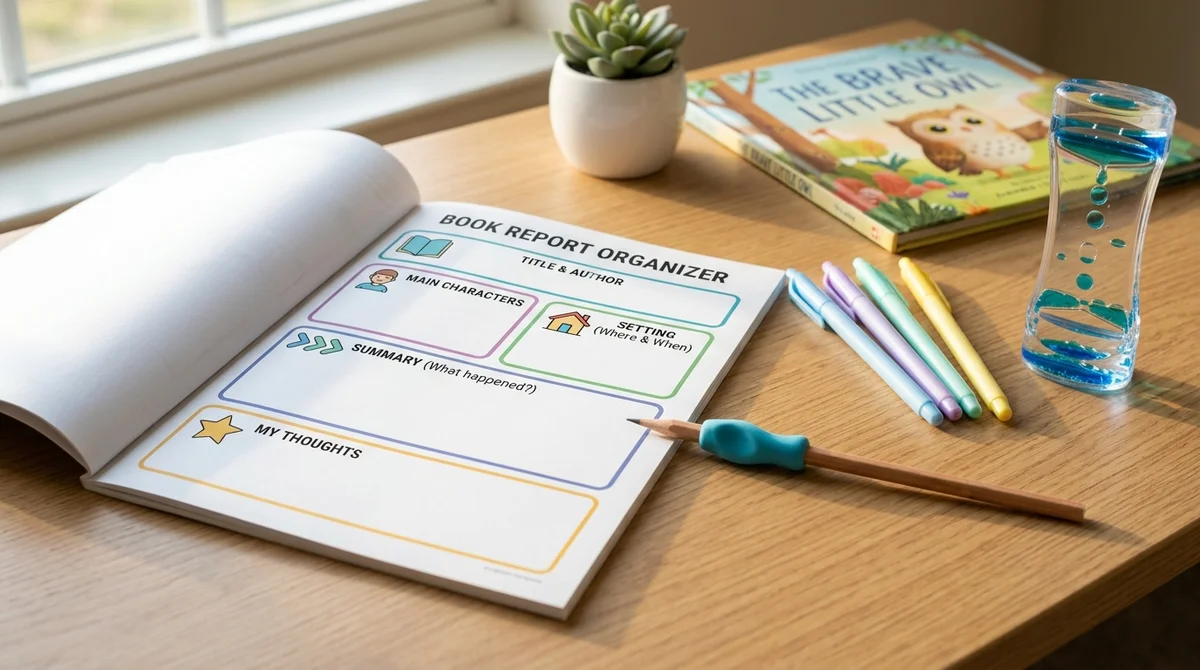 Figure: A sensory-friendly writing toolkit featuring structured graphic organizers, adaptive pencil grips, smooth gel pens, and visual timers removes graphomotor friction for autistic students.
4.1 Step 1: Special Interest Selection & Visual Story Mapping
Autistic children possess deep, intense passions. Whenever possible, select books tied directly to the learner’s hyperfixations or special interests (e.g., space exploration, trains, deep-sea animals, specific video game lore) to dramatically boost engagement, motivation, and creative output.
Once the book is read, do not jump straight to a blank page. Map out the character, setting, kick-off event, and resolution using visual story maps and Story Grammar Markers®. These visual tools provide a concrete, manipulatable representation of an abstract narrative, helping the child sequence events before writing.
4.2 Step 2: Executive Function Support via SRSD & “POW”
To support executive functioning, teach the evidence-based Self-Regulated Strategy Development (SRSD) mnemonic: POW. When implementing SRSD POW writing autism strategies, explicit and repeated strategy instruction is key. Teach the child to:
- Pick my idea (Identify the main theme or favorite part).
- Organize my notes (Use the graphic organizer).
- Write and say more (Expand the sentences).
This explicit strategy gives the child a memorable, step-by-step cognitive map. To further support organization, utilize color-coded paragraph maps to represent paragraph components visually. For example, use green highlighters for the topic sentence (Go), yellow for supporting details (Slow down and explain), and red for the conclusion (Stop) to show exactly where each thought belongs.
4.3 Step 3: Sentence Starters, Social Stories, & Word Banks
Staring at a blank page triggers paralyzing anxiety. Supply personal transition word banks and structured sentence frames so the child only has to fill in the missing information, dramatically lowering the cognitive load.
Provide frames like, “When [Character] went to [Setting], they felt…” or “However, when the problem started…” You can also use Social Stories to explain the purpose of different writing types, helping the child understand why they are summarizing the book for their teacher. Pair this with verbal retelling games to practice narrative flow before writing.
4.4 Step 4: TEACCH Structure & Positive Reinforcement
Following the TEACCH approach (Treatment and Education of Autistic and Related Communication Handicapped Children), set up a dedicated, low-distraction writing space.
Use explicit visual task schedules so the child knows exactly what is expected (e.g., 1. Write Name, 2. Fill out Setting box, 3. Take a break). Establish visual completion definitions so the child knows exactly when the task is over. Utilize visual countdown timers to help with pacing. Finally, provide immediate positive reinforcement using token systems or access to preferred activities to reduce anxiety, build self-esteem, and celebrate incremental efforts.
Printable Book Report Frameworks & Sentence Starters
For many neurodivergent learners, the format of the page is just as important as the content. Use the following structured outline as your baseline autistic child book report template. It visually segments the task, eliminating the overwhelm of unstructured lined paper and utilizing paragraph frames with clear, boxed sections.
[ BOOK REPORT VISUAL FRAMEWORK ]
 ┌───────────────────────────────────────────────────────────────┐
 │ 1. THE BOOK DETAILS (Title, Author, Main Character)           │
 │    "The title of this book is [ ___ ]."                       │
 │    "The story was written by [ ___ ]."                        │
 ├───────────────────────────────────────────────────────────────┤
 │ 2. THE SETTING & MAIN CHARACTER                               │
 │    "The story takes place in [ ___ ]."                        │
 │    "The main character is [ ___ ], who feels [ ___ ]."        │
 ├───────────────────────────────────────────────────────────────┤
 │ 3. THE PLOT SEQUENCE (Beginning, Middle, End)                 │
 │    "First, the character decided to [ ___ ]."                 │
 │    "However, the big problem happened when [ ___ ]."          │
 │    "After this, the problem was solved when [ ___ ]."         │
 ├───────────────────────────────────────────────────────────────┤
 │ 4. PERSONAL OPINION                                           │
 │    "My favorite part of the story was [ ___ ]."               │
 │    "I give this book [ 1-5 Stars ] because [ ___ ]."          │
 └───────────────────────────────────────────────────────────────┘
Copy-Paste Sentence Starter Bank:
- Character & Setting: “In this story, [Character] lives in…” / “When [Character] saw [Picture/Setting], they felt…”
- Plot Sequence: “First, [Event] happened…” / “However, when…” / “After this, [Resolution]…”
- Opinion & Perspective: “I liked this book because it was about…” / “If I were [Character], I would…”
Accommodations for Non-Speaking & Multimodal Communicators
Literacy and writing are not gated behind verbal speech. Non-speaking children or those who use multimodal communication methods can and should participate fully in writing book reports with appropriate technological and visual scaffolding. Providing multiple means of action and expression is a critical component of inclusive education.
6.1 AAC & Symbol-Supported Writing
For minimally speaking children, pair sight words and book report vocabulary directly with picture symbols on their speech-generating Augmentative and Alternative Communication (AAC) devices. As outlined in our complete guide on how to use AAC with your child at home, incorporating visual language symbols across academic tasks reinforces functional literacy.
By pre-programming a specific folder on their AAC device with the book’s core vocabulary (character names, settings, key actions), the child can tap the symbol to communicate a plot point while simultaneously interacting with the printed word. You can export these selected symbols directly into a document to serve as their written report.
6.2 Choice-Board Composition & Co-Writing
Allow students to construct their book report sentences by making structured choices from visual option boards. Present a sentence frame on a whiteboard and offer three visual picture-card choices for how to complete it.
Additionally, implement predictable chart writing and joint co-writing, where the adult facilitator and the student alternate turns generating the text. The adult might write, “The story is about a…” and the child selects the picture of a dog. Presenting writing prompts and instructions in various visual forms greatly lowers the cognitive demand on the child while effectively modeling the writing process.
Frequently Asked Questions (FAQ)
Why can my child read an entire chapter aloud fluently but fail to explain the plot?
This pattern typically indicates hyperlexia, where mechanical word-decoding abilities develop significantly ahead of underlying language comprehension. The child’s brain focuses entirely on the mechanics of print without simultaneously processing the narrative meaning. Scaffolding reading with short 2–3 sentence paragraph chunks and utilizing “Who, What, Where, When” intraverbal prompts helps close this gap, slowing the child down so their comprehension can catch up to their decoding speed.
Should I force my autistic child to handwrite their book report if they refuse?
No. Handwriting refusal is rarely behavioral defiance; it is almost always driven by sensory friction (such as an uncomfortable pencil grip or aversive paper texture) or genuine graphomotor fatigue. Forcing handwriting will only trigger anxiety, task avoidance, and potential meltdowns. Switching to whiteboards, gel pens, keyboarding, or speech-to-text dictation successfully separates the physical act of writing from the intellectual act of thought expression, allowing the child’s true creativity to shine.
How do I help my child express their personal opinion about a book?
Expressing abstract opinions requires perspective-taking and Theory of Mind skills that can be exceptionally difficult for autistic learners, who may struggle with abstract social concepts and open-ended questions. To support them, avoid broad questions like “What did you think?” Instead, provide concrete 1–5 star rating scales paired with visual choice options (e.g., a checkbox for “I liked it because it was funny / exciting / about space”). Use visual examples and models of completed writing assignments so they can see exactly what an “opinion” looks like on paper before they are asked to generate their own.
What should I do if book report anxiety escalates into a meltdown?
When academic overwhelm leads to an intense emotional crisis, step back from the assignment immediately. Distinguishing whether the crisis is a sensory-neurological collapse or a behavioral boundary testing situation is essential, as explained in our guide on autism meltdown vs. temper tantrum. Do not attempt to teach or enforce writing during an active meltdown; prioritize safety, reduce environmental stimulation, and offer co-regulation.
Conclusion & Parent Action Checklist
8.1 Summary of Core Principles
Figuring out how to help an autistic child write a book report requires patience, empathy, and a willingness to completely abandon traditional, neurotypical teaching methods. Success relies heavily on lowering the child’s anxiety, actively accommodating their sensory and motor needs, utilizing highly structured visual scaffolds, and celebrating every incremental effort the child makes.
Writing should never be a test of how well a child can mask their neurodivergence, endure physical discomfort, or memorize spelling rules under pressure. By implementing color-coded paragraph maps, providing sensory-friendly tools, separating the mechanics of handwriting from narrative thought, and ensuring comprehension precedes composition, you empower your child to share their unique perspective of the stories they read.
[!TIP] Free Caregiver Emergency Tool: When writing frustration or academic stress occasionally triggers intense neurological dysregulation, having a calm, predictable protocol is critical. Keep a printed copy of our Meltdown First Aid Checklist: Step-by-Step Actions for Caregivers on hand to de-escalate safely and re-establish emotional security before returning to schoolwork.
Utilizing these evidence-based frameworks will help bypass executive functioning friction, reduce homework battles, and bring the joy of storytelling back to your child’s educational journey.