
By Med Ka | Reviewed by the Med Ka Editorial Team · Published: October 2026
Above-the-Fold Key Takeaways
- Pretend Play is a Composite Skill: It is not a single spontaneous reflex, but a multi-layered cognitive process combining abstract thinking, flexible problem-solving, and symbolic representation, according to developmental guidelines from the American Academy of Pediatrics (AAP).
- Development is Non-Linear: Autistic play often centers heavily on functional, sensory, or scripted patterns before transitioning to symbolic play. These early stages are entirely valid and serve vital regulatory functions for a child’s nervous system.
- Direct, Low-Demand Teaching Works: Strategies like gentle modeling, utilizing familiar daily routines, starting with realistic functional toys, and expanding upon special interests make pretend play accessible and exciting for neurodivergent minds.
- The Ultimate Goal: The focus of play support is never to force neurotypical conformity or eliminate a child’s natural play style. The true goal is expanding cognitive flexibility, enhancing communication, and fostering emotional expression through shared joy and authentic connection.
Learning how to encourage imaginative play in autism is one of the most rewarding, yet frequently misunderstood, milestones a parent, caregiver, or educator can support. While neurotypical children might naturally pick up a wooden block and pretend it is a ringing smartphone or turn an ordinary cardboard box into an interstellar spaceship, autistic children often experience the physical world—and play—quite differently. For many neurodivergent children, toys are deeply fascinating for their literal, mechanical, or sensory properties, rather than for the imaginary worlds they could potentially represent.
However, differences in play styles do not mean that imaginative play is impossible or that your child lacks an imagination. With a supportive, neurodiversity-affirming approach, autistic children can learn to engage in expansive, joyful pretend play. As outlined in our companion guide on how to teach pretend play to an autistic child, understanding these cognitive differences and learning how to gently expand upon your child’s natural inclinations opens up profound avenues for emotional regulation, language acquisition, and lifelong connection.
This comprehensive guide breaks down the developmental science of autistic play patterns, helps you identify your child’s current milestone stage, and provides highly actionable, research-backed strategies to cultivate imagination and cognitive flexibility at home.
What Is Symbolic & Pretend Play in Autism?
When parents search for information on symbolic play autism, they are usually seeking ways to help their child move beyond literal, repetitive play. But what exactly is pretend play from a developmental perspective?
At its core, pretend play is the cognitive capacity to step outside of literal reality and use imagination to assign new, invented meanings to objects, actions, or ideas. It requires the brain to hold two contrasting concepts simultaneously: “I know this is a plain plastic cup, but right now, it is a hat for my teddy bear.”
For many autistic children, play initially remains literal: toys are explored strictly for their intended mechanical function or for the tactile feedback they provide. A toy car is spun for the visual rhythm of its rotating wheels, and blocks are arranged in precise rows to establish satisfying visual order.
To teach imaginative skills effectively, play researchers and developmental specialists divide pretend play into four core, teachable components. Mastering these one by one builds the foundation for complex creative play.
The 4 Core Skill Components of Pretend Play
1. Object Substitution
Object substitution pretend play is the ability to use one physical object to represent an entirely different object. Because the autistic brain tends to be highly logical and literal, this is often a significant cognitive hurdle. If a child sees a yellow wooden block, their brain categorizes it exactly as that: a rectangular piece of wood. Asking them to hold it to their ear as a telephone defies their literal processing.
- What it looks like in practice: Using a stick from the yard as a magic wand, pretending a yellow wooden block is a piece of cheese for a toy mouse, or holding a frisbee as a vehicle steering wheel.
- Why it matters: Object substitution is the root of abstract thinking, which is essential for advanced language comprehension, understanding metaphors, and flexible problem-solving.
2. Attribution of Properties
This involves treating an object as if it possesses unseen traits, physical states, or feelings that are not physically present. It requires the child to project abstract concepts (like temperature, emotion, or mechanical failure) onto inanimate items.
- What it looks like in practice: Pretending a stuffed animal is “exhausted” and tucking it into bed, acting as though a toy car is “broken” and needs a mechanic to inspect the engine, or pretending a cup of toy soup is “too hot” and gently blowing on it.
- Why it matters: This component builds early empathy and emotional identification. By projecting feelings onto a toy, the child practices recognizing those emotional states in themselves and others.
3. Role Play
Role playing in autism involves taking on a character, alternative persona, or job title. This step is extraordinarily valuable because it allows children to rehearse social scenarios and problem-solving in a safe, predictable, and low-stakes environment.
- What it looks like in practice: Role-playing familiar, everyday scenarios—such as pretending to be a grocery store cashier scanning items, a doctor checking a patient’s heartbeat with a toy stethoscope, or a chef serving pretend meals.
- Why it matters: Role play helps autistic children map out social expectations. It acts as a behavioral rehearsal for real-world events, reducing anxiety when they encounter these situations (like an upcoming dental appointment or doctor’s checkup) in daily life.
4. Sequencing
Sequencing is the advanced ability to string multiple distinct pretend actions into a cohesive mini-narrative or storyline. Instead of performing a single action repeatedly, the child constructs a chronological chain of events.
- What it looks like in practice: Cooking pretend food on a toy stove (Step 1), serving it onto a plate (Step 2), pretending to eat it with a spoon (Step 3), and washing the dishes in a toy sink (Step 4).
- Why it matters: Sequencing in play directly correlates to narrative language development (telling a story with a beginning, middle, and end) and executive functioning (planning and executing multi-step daily routines like getting dressed for school).
The 5 Developmental Stages of Symbolic Play
Understanding the stages of pretend play in autism helps caregivers identify exactly where a child currently stands and what the next logical developmental milestone should be. Play advances sequentially; expecting a child to engage in cooperative sociodramatic play with peers before they have mastered self-directed symbolic play causes frustration and withdrawal.
The table below outlines the progression of play, highlighting how it typically manifests in autistic children and the next affirming milestone to target.
| Play Stage | Typical Age Range | Autistic Play Manifestation | Key Milestone Target |
|---|---|---|---|
| Pre-Symbolic (Sensory) | 8–12 Months | Explores toy properties through sensory feedback (mouthing, tapping, dropping, spinning, or sorting items). | Understanding object function and physical properties. |
| Early Symbolic | 12–18 Months | Simple, self-directed pretend play (e.g., bringing an empty toy cup to their own mouth to drink, or closing eyes to pretend to sleep). | Directing pretend actions toward the self. |
| Decentered Symbolic | 18–24 Months | Pretend actions directed outward toward others or toys (e.g., feeding a doll with a toy spoon or brushing a teddy bear’s hair). | Extending pretend actions to toys, action figures, or caregivers. |
| Combined / Complex | 24–36 Months | Combining 2 or more pretend actions into a sequence (e.g., feeding a doll, wiping its mouth with a napkin, and putting it to bed with a blanket). | Building multi-step storylines and basic narratives. |
| Sociodramatic Play | 3–5+ Years | Cooperative play with peers involving shared roles, negotiation of rules, and complex scripts (e.g., playing “House”, “Store”, or “Space Station”). | Cooperative imaginative scenarios, flexibility, and peer interaction. |
[!NOTE] Clinical Developmental Note: Autistic children frequently reach these stages at different ages than their neurotypical peers, may remain in specific stages longer, or may exhibit advanced symbolic play exclusively within special interests. Always meet your child where they currently are, rather than focusing on rigid chronological age expectations.
Understanding Autistic Play Patterns
Before you can actively foster new forms of play, you must validate and deeply respect existing autistic play patterns. Autistic children often engage in play that looks different from typical peers, but it is deeply meaningful, highly regulating, and serves a vital physiological purpose for their nervous system.
The goal of play support is never to eliminate these natural play preferences. Taking away a child’s preferred toys or routines causes intense distress and ruptures relational trust. Rather, the goal is to gently introduce flexibility and expand the child’s imaginative repertoire so they have more tools for connection.
1. Repetitive Functional Play (Stimming through Play)
This type of play involves interacting with the sensory or physical properties of objects rather than their symbolic or social function.
- What it looks like: Spinning cups on the floor to watch the blur of colors, lining up toy cars in perfect color-coded rows, repeatedly opening and closing doors on a toy garage, or tapping blocks together to hear their acoustic resonance.
- The “Why”: Rather than dismissing this as “non-functional” play, recognize that sorting and lining up toys provides visual order, predictability, and sensory regulation. For a child navigating an overstimulating world, this predictability calms an overwhelmed nervous system, as detailed in developmental research archived by the National Institutes of Health (NIH / PMC).
2. Scripted or Rigid Play (Gestalt Processing)
Many autistic children play by recreating exact scenes from favorite television shows, audiobooks, movies, or YouTube videos without deviation.
- What it looks like: Running a toy train set only in a fixed sequence, using the exact dialogue, tone, and pacing from a specific animated episode. If a parent or sibling attempts to change the script or move a character out of turn, the child may become intensely distressed.
- The “Why”: Scripted play brings immense comfort through predictability. Furthermore, scripting is intimately tied to Gestalt Language Processing (GLP). The child is practicing complex linguistic frameworks in a safe, predictable loop. They are not lacking imagination; they are rehearsing real-world narratives.
3. Literal Play
Literal play manifests as a strong preference for realistic toys over abstract substitutes.
- What it looks like: The child insists that a toy smartphone must look and feel like a real device. If you hand them a plain wooden block and say, “Ring ring, hello?”, they may drop the block, correct you, or walk away.
- The “Why”: The autistic brain is beautifully detail-oriented and logical. Asking them to ignore the physical reality of a block requires overriding their logical processing. They see the block for what it is, not what it could be. Bridging this gap requires gentle, gradual scaffolding.
7 Research-Backed Strategies to Encourage Pretend Play at Home
If you are wondering how to encourage imaginative play in autism, the most effective approach relies on gentle, incremental, and highly motivating strategies. You are not trying to force a change; you are building a bridge between their current passions and new cognitive skills.
1. Start with Familiar, Everyday Routines
Begin with scripts the child already experiences in daily life. A pretend “bedtime” routine for a plush animal or a “lunchtime” sequence for a doll is much easier to grasp than an abstract fantasy quest.
- Action Step: Choose a routine your child enjoys (e.g., evening bath time). Provide a washable plastic doll and a small container of water. Narrate the steps exactly as they occur in real life: “First clothes off. Into the warm bath. Scrub scrub with the washcloth! Now wrap in the cozy towel.” Familiar routines provide a script the child already understands, freeing up cognitive energy to focus on the pretending aspect.
2. Model and Narrate Actions (Without Demands)
Many neurodivergent children experience anxiety when placed under a testing spotlight. Instead of giving verbal instructions or asking quizzing questions (e.g., “Can you feed the teddy?” or “What sound does the engine make?”), utilize declarative language and natural modeling.
- Action Step: Simply demonstrate the pretend action yourself while narrating out loud: “Mmm, fresh juice! The bear is thirsty. Pour, pour, drink!”
- The Science: Children absorb pretend actions significantly faster through low-pressure observation. Mirror neurons activate naturally through observational engagement without the performance anxiety of mandatory compliance.
3. Incorporate Special Interests (SPINs)
Leverage your child’s specific passions to ignite intrinsic motivation. If your child loves trains, transit maps, outer space, or dinosaurs, integrate those passions into the play.
- Action Step: If your child loves astronomy, do not force them to play “restaurant.” Instead, set up a “Lunar Supply Station.” A dinosaur that is “stopping for groceries” or a train that “needs a tune-up at the repair yard” connects imaginative thinking directly to their intrinsic joy.
4. Expand in Small Increments (The “+1 Rule”)
If your child can already execute one pretend action, such as feeding a stuffed puppy with a spoon, join their play and introduce just one minor addition.
- Action Step: If they consistently feed the puppy, sit alongside them and participate in this exact routine for several minutes. Once they feel comfortable and safe, offer a small washcloth to wipe the puppy’s face: “Messy puppy! Wipe, wipe, clean!” If they accept the addition, celebrate the milestone. If they reject it, back away calmly and try again another day.
5. Structure Safe, Organized Play Spaces
A cluttered room with flashing electronic toys, loud background noise, and chaotic piles of pieces can overwhelm sensory processing. As explored in our guide on how parents of autistic kids handle sensory overload, an overstimulated nervous system focuses entirely on survival, leaving zero cognitive bandwidth for imagination.
- Action Step: Implement toy rotation—keeping only 3 to 4 engaging toys visible at a time—to reduce visual overwhelm. When a child’s environment feels calm and organized, their prefrontal cortex can fully relax into creative play.
6. Transition from Functional Toys to Abstract Substitutes Gradually
Transitioning directly to abstract object substitution can be jarring for a literal mind. Walk them down the abstraction ladder gradually:
- Realistic Prop: Start with a highly realistic toy (e.g., a detailed plastic apple and a ceramic plate).
- Semi-Realistic Prop: Move to a slightly less realistic item (e.g., a felt or fabric apple).
- Shape & Color Match: Introduce an item that shares only color and general geometry (e.g., a smooth red wooden ball).
- Pure Abstraction: Finally, transition to a fully abstract item (e.g., a plain, unpainted wooden cube).
7. Follow Their Lead (The Floortime Approach)
The most transformative play moments occur when adults enter the child’s world rather than demanding they enter ours.
- Action Step: If your child is lining up cars on the carpet, sit quietly beside them and line up a car in parallel. Narrate your actions in a calm, soothing voice. By joining their play without taking control, you build profound emotional safety. Once that connection is solid, you can gently introduce symbolic variations.
Multimodal Communication: Integrating AAC into Play
Play does not require spoken words. As emphasized in our complete caregiver resource on how to use AAC with your child at home, speech-generating devices, communication boards, and picture cards belong right in the middle of playtime.
- Core Vocabulary in Action: Model simple action words on your child’s AAC device during play—such as “go”, “stop”, “more”, “fast”, “uh-oh”, or “all done”.
- Respect All Communication Modalities: Whether your child communicates through vocalizations, physical gestures, pointing, or AAC buttons, treat their input as meaningful contributions to the pretend narrative.
Printable Play Routine Scripts (For Caregivers)
To help you get started at home, here are four low-pressure play scripts designed to bridge repetitive functional actions into dynamic pretend sequences.
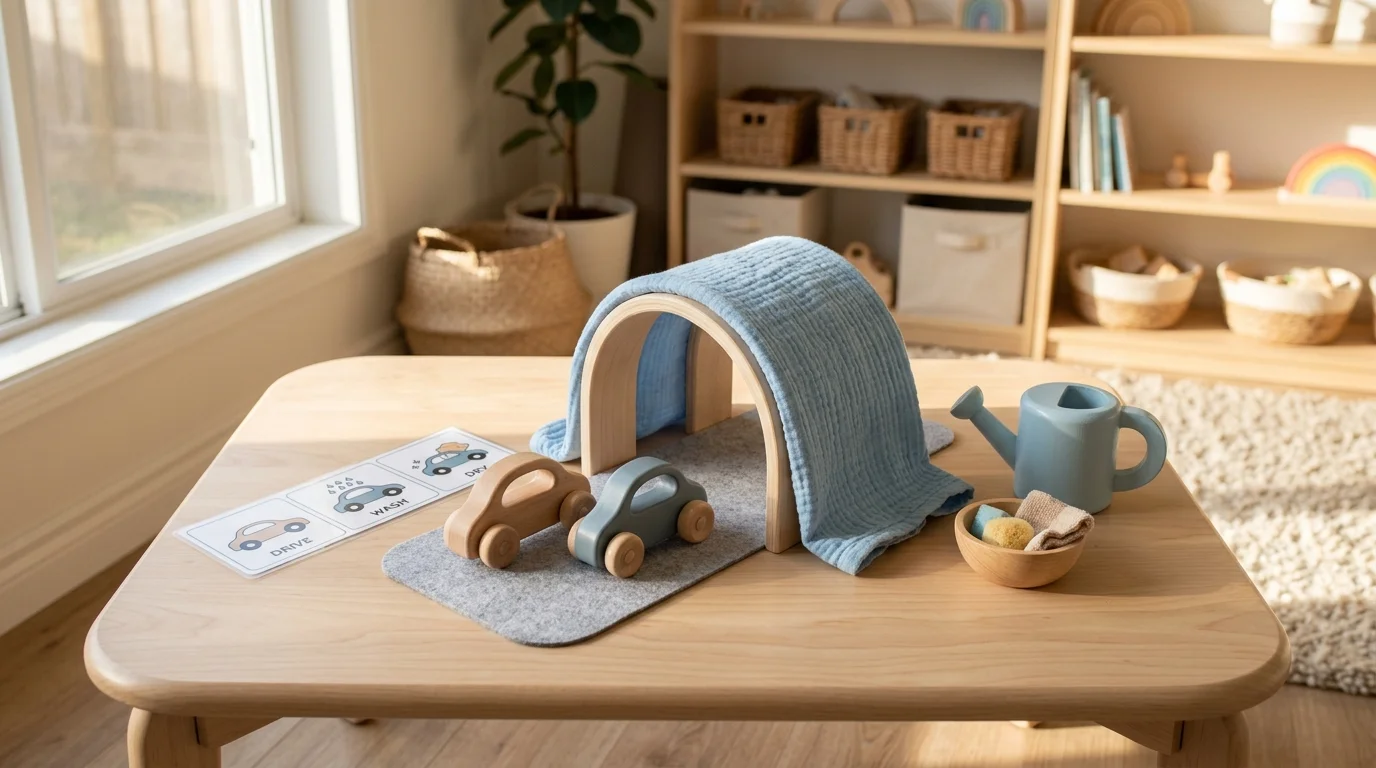 Figure: Step-by-step visual routines, such as a gentle toy car wash, help autistic children bridge repetitive functional actions into dynamic pretend sequences.
Routine 1: The Toy Car Wash
Bridges the gap between repetitive functional play (lining up cars, spinning wheels) and early narrative sequencing.
- Best for: Children fascinated by vehicle wheels, alignment, and physical cause-and-effect.
- Step 1 (Join): Line up toy cars side-by-side with your child, respecting their existing rhythm.
- Step 2 (The Pretend Spark): Drape a soft blue cloth over a low cardboard box: “Oh no, the cars are dusty! Time for the car wash.”
- Step 3 (Action): Push one car under the cloth, making a fun scrubbing sound (“Swish, scrub, clean!”), and bring it out the other side.
- Step 4 (Expansion): Park the clean car in a new row and invite your child to take a turn: “Your turn! Drive into the wash!”
Routine 2: Teddy’s Doctor Visit
Introduces property attribution, fosters body awareness, and demystifies medical appointments.
- Best for: Children moving into decentered symbolic play who can project actions onto a doll or figure.
- Step 1 (Set the Scene): Sit with your child and their favorite plush animal. Provide simple props: a toy stethoscope, a popsicle stick, and a real band-aid.
- Step 2 (Attribution): Gently touch the bear’s forehead: “Teddy has a little sniffle. Let’s help Teddy feel better.”
- Step 3 (Action): Place the stethoscope on the bear’s chest: “Thump thump, healthy heart! Deep breath in, breath out.”
- Step 4 (Resolution): Apply a band-aid to Teddy’s arm. Ask your child: “Can you give Teddy a gentle hug so he knows he is safe?”
Routine 3: The Grocery Store Checkout
Transforms categorizing and sorting habits into a cooperative social game.
- Best for: Children who love pressing buttons, categorizing items by color, or organizing pantry goods.
- Step 1 (Set the Scene): Gather three realistic play food items, a reusable bag, and a toy scanner or calculator.
- Step 2 (Action): Hand the child an apple and say “Beep!” as they touch it to the counter.
- Step 3 (Role Play): Act as the shopper while your child is the cashier. Hand them a slip of paper as pretend money: “Thank you for bagging my groceries!”
Routine 4: The Sleepy Train Station
Utilizes train hyperfixations to teach property attribution and emotional transitions.
- Best for: Children who engage in rigid track routines with model trains.
- Step 1 (Set the Scene): Allow your child to assemble the track and run the train as they normally do.
- Step 2 (Attribution): Introduce a small flannel cloth: “The train worked hard all day. The engine is so sleepy. Chugga-chugga-yawn.”
- Step 3 (Action): Stop the train at a block “station” and drape the cloth over it: “Night night, engine. Rest your wheels.”
- Step 4 (Expansion): After a few quiet seconds, gently lift the cloth: “Ding ding! Morning sunshine! Time to roll!”
Frequently Asked Questions (FAQ)
Is a lack of pretend play a definitive sign of autism?
While delays or differences in symbolic play are common early developmental markers, an autism diagnosis requires a comprehensive clinical evaluation across social communication, sensory profiles, and behavioral patterns, as detailed by the Centers for Disease Control and Prevention (CDC). Differences in play alone do not constitute a diagnosis, but they highlight areas where gentle developmental support can be beneficial.
How do I handle a child who strongly prefers repetitive or sensory play over my ideas?
Start by joining their preferred play and deeply respecting their rhythm. Do not confiscate their toys, physically block their stimming, or force them to follow your agenda. Gradually introduce small variations using their absolute favorite special interests. If they resist an addition, back away immediately. Play must always be founded on mutual enjoyment and zero pressure.
What if my child gets distressed or has a meltdown when I change their play script?
If a child becomes distressed when a play routine is altered, it indicates that the cognitive or emotional demand exceeded their current bandwidth. Back down immediately and return to their familiar script to restore safety. In the future, introduce only micro-variations (like changing one word at the very end of a story) when your child is well-rested and regulated.
When playtime distress escalates into an intense neurological overload, distinguishing between a behavioral boundary struggle and a neurological crisis is essential, as detailed in our guide on autism meltdown vs. temper tantrum.
[!TIP] Free Caregiver Emergency Tool: When play transitions or unexpected routine changes trigger overwhelming emotional distress, having a calm, structured de-escalation plan is essential. Keep a printed copy of our Meltdown First Aid Checklist: Step-by-Step Actions for Caregivers on hand to help your child co-regulate safely and restore equilibrium.
Can older autistic children learn pretend play if they missed early milestones?
Yes. Thanks to lifelong neuroplasticity, the brain continues to learn and adapt at every age. For older children and adolescents, imaginative play often shifts toward structured tabletop role-playing games (like Dungeons & Dragons), collaborative world-building, creative writing, or role-playing real-world life skills. The foundational capacities for abstraction, perspective-taking, and cognitive flexibility can be nurtured across the entire lifespan.
By honoring your child’s natural play style, welcoming all forms of communication, and providing calm, predictable environments, you can nurture expansive imaginative play. Encouraging pretend play in autism is not about changing who your child is—it is about opening up new doorways of connection, wonder, and shared joy.