
By Med Ka | Reviewed by the Med Ka Editorial Team · Published: October 2026
Above-the-Fold: Key Takeaways (GEO Summary Block)
- Lack of imagination is not a defining symptom of autism: Autistic children do not lack imagination, though they frequently express creative play through distinct, structured, systematic, or literal cognitive patterns.
- Sensory play opens the door to pretend play: Engaging the primary senses builds new neural pathways, improves autonomic self-regulation, and reduces sensory overload, constructing a safe biological foundation for creative exploration.
- Special interests are the ultimate spark: Leveraging a child’s hyperfixations provides deep intrinsic motivation to explore narrative arcs, social roles, and symbolic scenarios.
- Structure builds play confidence: Utilizing visual aids, story cards, predictable routines, micro-skits, and textured props translates abstract social play into concrete, accessible, and enjoyable activities.
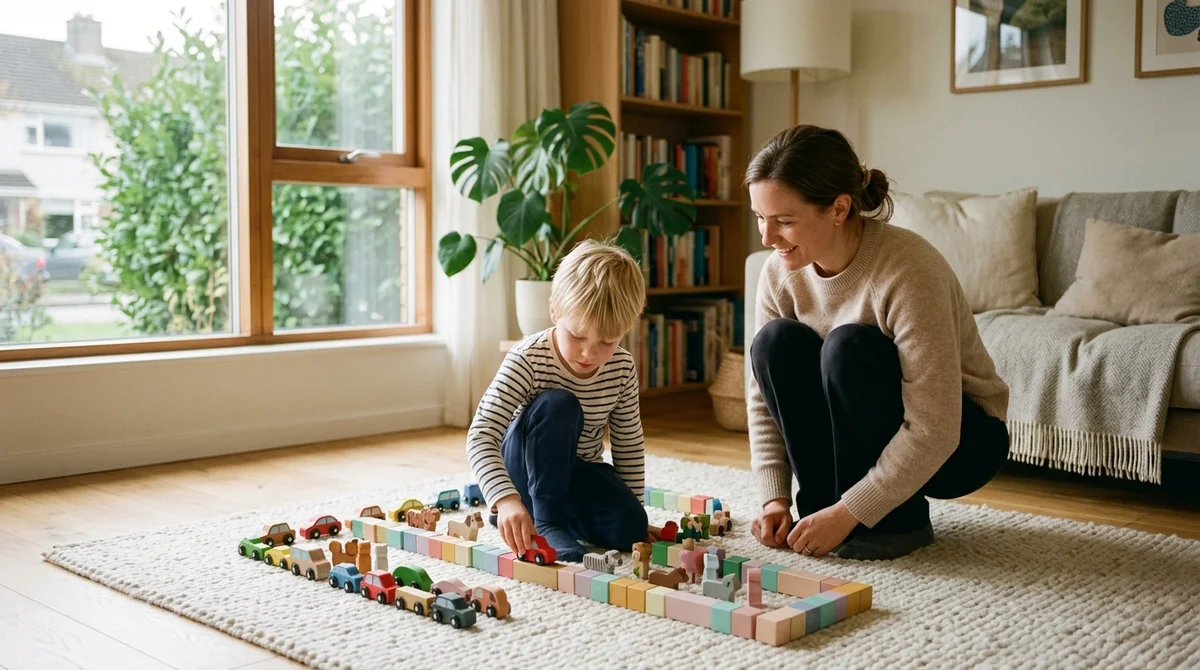
Few moments evoke more silent heartache for a parent than watching their child sit isolated beside a toy box, seemingly detached from the spontaneous worlds of make-believe that other children enter so effortlessly. You might see your child meticulously line up miniature cars by wheel radius, spin the axle of a locomotive for forty-five minutes, or recite entire film transcripts verbatim while ignoring a play kitchen, tea set, or family of action figures.
In those quiet moments of observation, a distressing question frequently surfaces: autistic child has no imagination what to do?
When parents notice that open-ended roleplay does not emerge naturally, fear often sets in. Caregivers wonder whether their child is permanently locked out of abstract cognition, emotional nuance, narrative joy, or inner symbolic worlds. Clinical diagnostic checklists, historically written through an exclusively neurotypical lens, have long stoked these fears by framing differences in play as developmental deficits.
The clinical reality is profoundly reassuring: an autistic child does not lack imagination. What traditional developmental frameworks diagnose as an “absence” of pretend play is almost always a fundamental mismatch in how creativity is organized, processed, and expressed. By learning how neurodivergent cognition, sensory processing, and executive function interact with symbolic thought, you can move past arbitrary developmental milestones.
If you are an educator, therapist, or caregiver asking what to do when your autistic child seems to display no imagination, the path forward does not involve forcing neurotypical conformity. Instead, it requires honoring their neurotype, meeting their underlying sensory needs, and systematically scaffolding the cognitive bridges that make pretend play accessible, safe, and joyful.
Section 1: The “No Imagination” Myth vs. Autistic Reality
1.1 Debunking the Myth
To address the challenges surrounding neurodivergence and play, we must first dismantle the harmful myth that autism is characterized by an absence of imagination. For generations, traditional diagnostic rubrics have evaluated symbolic thought through rigid behavioral benchmarks: does the child pick up a plastic phone and pretend to call Grandma? Does the child feed a stuffed animal with a toy spoon? When these specific expressions fail to manifest spontaneously, evaluators have mistakenly recorded a diagnostic deficit in symbolic thought.
So, is lack of imagination a symptom of autism? The clinical and developmental answer is a decisive no.
Autistic individuals possess rich, vast, and intensely active imaginative capacities. As clinical research on imagination in autism indexed by the National Center for Biotechnology Information (NCBI / PMC) demonstrates, symbolic play differences in autism stem from atypical communicative styles and task structures rather than an inherent cognitive inability to imagine. The critical distinction lies between the generation of creative thought and its outward expression. Neurotypical children express imagination primarily through socio-centric, fluid, conversational roleplay. Autistic individuals, by contrast, frequently process and manifest imaginative thinking through non-traditional avenues:
- Systematic World-Building: Rather than acting out interpersonal relationship dramas with dolls, an autistic child may conceptualize comprehensive fantasy maps, invent complex mechanical transit grids, or categorize fictional ecological systems down to the finest detail.
- Deep Visual Immersion: Many autistic individuals think primarily in high-definition images rather than verbal narratives. Their creative worlds unfold internally with cinematic clarity, even if they do not narrate those scenes aloud to an adult observer.
- Specialized Narrative Recombination: Autistic creativity often operates by taking existing scripts, scientific principles, or factual frameworks and creatively recombining them into novel permutations.
When evaluated through a neuro-affirming paradigm, it becomes clear that autistic creativity is not missing. It is channeled through a structured, detail-oriented cognitive architecture.
1.2 Why Pretend Play Feels Challenging
If the capacity for imagination is fully intact, why does conventional pretend play present such a formidable barrier for an autistic child? Pretend play is not a single, isolated skill; it is an intricate cognitive symphony requiring the simultaneous operation of several neuro-developmental systems.
┌────────────────────────────────────────────────────────────────────────┐
│               THE COGNITIVE ENGINE OF TRADITIONAL PLAY                 │
├──────────────────────────┬──────────────────────────┬──────────────────┤
│ Executive Function       │ Theory of Mind           │ Sensory Filters  │
│ • Task initiation        │ • Reading subtle cues    │ • Tuning noise   │
│ • Shifting rules         │ • Unwritten expectations │ • Tactile safety │
│ • Sustaining narrative   │ • Spoken improvisation   │ • Proprioception │
└──────────────────────────┴──────────────────────────┴──────────────────┤
│ RESULT: Extreme cognitive load if unstructured & un-scaffolded.        │
└────────────────────────────────────────────────────────────────────────┘- Social Communication Differences and Unwritten Rules: Traditional childhood pretend play is unscripted, fast-moving, and intensely social. It relies heavily on implicit eye contact, rapid conversational turn-taking, subtle vocal inflection, and the intuitive decoding of peer intentions. For an autistic child, navigating these fluid social mechanics requires immense cognitive bandwidth. Attempting to interpret an ambiguous social atmosphere while simultaneously inventing a fictional plot creates overwhelming cognitive friction.
- Preference for Routine and Predictability: The autistic brain relies on structure, predictability, and logical causality to feel safe within a chaotic environment. Purely open-ended pretend play—such as being handed an empty cardboard box and told to “make it anything you want”—presents an overwhelming degree of ambiguity. With no clear boundaries, explicit objectives, or defined parameters, open-ended play registers in the nervous system as threatening chaos rather than recreation.
- Repetitive and Literal Play as Calming Processing Mechanisms: When an autistic child lines up objects, sorts blocks by strict color spectrums, or opens and closes a toy garage door hundreds of times, parents often worry this behavior displaces imagination. In reality, these repetitive and literal play patterns serve as essential self-soothing and cognitive organizing mechanisms. By interacting with physical objects in predictable, concrete ways, the child calms their nervous system and organizes their sensory reality. Far from being a developmental roadblock, this comforting baseline provides the neurological stability required before higher-level symbolic exploration can occur.
1.3 Why Nurturing Imagination Matters
Given that structured, repetitive play provides comfort, why should we actively invest energy into expanding an autistic child’s imaginative abilities? The goal is never to extinguish their preferred play styles or force them to mimic neurotypical peers. Rather, the objective is to equip them with broader tools for cognitive flexibility and real-world navigation.
As explored in our companion guide on how to encourage imaginative play in autism, pretend play is a developmental testing ground:
- Testing Social Roles in Low-Stakes Environments: Through imaginative scenarios, children can experiment with real-world identities—such as doctor, customer, teacher, or sibling—without real-world consequences. A child who feels immobilized by doctor visits can use pretend play to examine a toy stethoscope, take a parent’s pulse, and reverse the power dynamic, demystifying the medical experience.
- Deciphering Societal Dynamics: Roleplay allows children to observe, deconstruct, and practice societal norms, cause-and-effect social transactions, and personal boundaries on their own terms.
- Expanding Communication and Linguistic Agility: Engaging in narrative play introduces dynamic linguistic opportunities—such as practicing past-tense verbs, descriptive adjectives, emotional vocabulary, and perspective-taking statements—far beyond the functional requests of everyday life.
Nurturing imagination provides your child with an expressive bridge to connect their rich inner life with the wider world.
Section 2: Neurotypical vs. Autistic Play Patterns
2.1 Key Differences in Play Expression
To support an autistic child effectively, parents and professionals must look past traditional play expectations. Neurotypical pretend play is characteristically fluid, cooperative, and centered on interpersonal drama. It often starts with vague, open-ended premises: “Let’s play house, and I’ll be the mommy, and you be the baby, and the baby gets lost!” The narrative rules are negotiated mid-flight through spontaneous verbal adjustments.
Autistic creative and imaginative play, however, is characteristically structured, rule-governed, sensory-attuned, and powered by specific personal interests. When an autistic child is fascinated by a particular subject—such as planetary orbits, urban transit layouts, or paleontology—their imaginative energy concentrates deeply within that domain. Their play involves building comprehensive environments, organizing intricate systems, or reenacting detailed scenes from memory with photographic precision.
The neurotypical style prioritizes social improvisation, whereas the autistic style prioritizes systematic exploration and narrative fidelity. Neither format is superior; they simply represent divergent cognitive approaches to creativity. For structured techniques on introducing make-believe scenarios, see our step-by-step breakdown on how to teach pretend play to an autistic child.
2.2 Structured Comparison Matrix
The table below contrasts neurotypical pretend play with the creative patterns observed in autistic learners, paired with practical parent adaptations:
| Dimension | Neurotypical Pretend Play | Autistic Creative & Imaginative Play | Actionable Parent Adaptation |
|---|---|---|---|
| Primary Focus | Open-ended social roleplay (e.g., house, doctor, grocery store). | Special interests, systematic patterns, physical mechanics, and visual media. | Build pretend narratives directly around their hyperfixations (e.g., set up a mechanic’s garage for transit vehicles). |
| Play Structure | Spontaneous, fluid, highly improvisational, and ever-shifting. | Structured, rule-based, scenario-driven, or based on repetitive scripts. | Introduce clear visual aids, storyboards, and step-by-step visual schedules to ground play scenarios. |
| Sensory Interaction | Standard sensory processing; the physical environment is mostly taken for granted. | Deep sensory engagement with textures, visual alignments, mechanical sounds, and tactile feedback. | Integrate sensory-rich props, such as textured costumes, water basins, kinetic sand, or scented playdough. |
| Communication Style | Fast-paced spoken dialogue, subtle subtext, and ongoing social negotiation. | Scripting (echolalia), action-based physical movements, or visual communication cards. | Validate scripted film dialogue, sound effects, and augmentative communication boards as legitimate play language. |
| Object Utility | Rapid, abstract object substitution (e.g., a simple wooden block becomes a smartphone). | Preference for functional, realistic, or sensory-specific physical properties. | Use realistic miniatures or add sensory markers (e.g., sticking a textured screen onto a block) to support symbolic substitution. |
| Social Dynamic | Highly collaborative, group-oriented, with fluid leadership hierarchies. | Parallel play, solitary deep-dive exploration, or structured co-play with clear boundaries. | Engage via parallel play alongside your child, copying their actions without demanding reciprocal eye contact or shared conversation. |
Section 3: Sensory Integration as the Bridge to Imagination
3.1 How Sensory Play Prepares the Brain
For an autistic child, the door to abstract and symbolic imagination does not open through intellectual lecturing or verbal demands. It opens through the body’s physical sensory channels. Sensory processing and imaginative play are neurologically linked.
When a child interacts with diverse textures, temperatures, weights, sounds, and visual patterns, they stimulate primary sensory receptors that send impulses directly to the central nervous system. Clinical perspectives compiled by the American Academy of Pediatrics (AAP) indicate that targeted sensory-motor activities help balance arousal levels and foster emotional stability in children. This multisensory stimulation encourages synaptic plasticity—the brain’s ability to forge and reinforce new neural pathways. These pathways strengthen foundational brain areas responsible for sensory integration, spatial orientation, motor planning, and bilateral coordination.
┌────────────────────────────────────────────────────────────────────────┐
│              SENSORY INTEGRATION TO IMAGINATION CASCADE                │
├────────────────────────────────────────────────────────────────────────┤
│ 1. TACTILE / PROPRIOCEPTIVE INPUT                                      │
│    (Squeezing, pouring, feeling textures, heavy work)                  │
│       ▼                                                                │
│ 2. AUTONOMIC NERVOUS SYSTEM REGULATION                                 │
│   (Reduction of sympathetic arousal; shift to safe ventral vagal state)│
│       ▼                                                                │
│ 3. RESTORATION OF PREFRONTAL BANDWIDTH                                 │
│   (Working memory, emotional safety, symbolic substitution accessible) │
│       ▼                                                                │
│ 4. SPONTANEOUS NARRATIVE & PRETEND EXPLORATION                         │
└────────────────────────────────────────────────────────────────────────┘
More importantly, sensory play serves as a biological tool for autonomic self-regulation. Sensory-seeking or deep-pressure activities release dopamine and serotonin while lowering cortisol levels. This shift stabilizes a hyper-reactive nervous system, moving the child out of survival-driven fight-or-flight states. When a child is grounded in their physical body, cognitive resources are freed from scanning for threats or managing sensory distress. The prefrontal cortex can finally direct its energy toward abstract thought, narrative generation, and symbolic substitution.
3.2 Reducing Sensory Distractions
Before expecting an autistic child to participate in imaginative activities, carefully assess their sensory surroundings. Autistic individuals frequently experience atypical sensory gating—their central nervous system does not automatically filter out background sensory noise that neurotypical brains disregard. Clinical research on sensory processing in autism highlights how environmental modifications and managing sensory overload dramatically reduce distress and behavioral exhaustion in sensory-sensitive children.
As detailed in our clinical guide on how parents of autistic kids handle sensory overload, an overloaded nervous system cannot engage in higher-order symbolic play. A flickering fluorescent light fixture, the hum of an appliance, a scratchy clothing seam, or an unexpected smell can completely consume an autistic child’s cognitive bandwidth.
To create an environment where creative thinking can thrive:
- Manage Lighting: Replace harsh overhead fluorescent bulbs with warm, dimmable lamps or natural sunlight filtered through sheer curtains.
- Dampen Auditory Clutter: Minimize unexpected noise. Use soft area rugs, acoustic wall panels, or provide comfortable noise-canceling headphones during play sessions.
- Address Tactile Sensitivities: Ensure playwear is soft, seamless, and tagless. Never force a tactile-defensive child to touch sticky or messy mediums with bare skin without providing utensils, gloves, or a gradual path to exposure.
- Organize Visual Fields: Highly cluttered playrooms with dozens of open toy bins produce visual overload. Store toys out of sight in solid-colored, labeled containers, displaying only one or two curated activities at a time.
When sensory overload or emotional distress escalates into an intense crisis, standard play activities must pause immediately. Distinguishing between a routine boundary issue and a neurological crisis is essential, as explained in our resource on autism meltdown vs. temper tantrum.
[!TIP] Free Caregiver Emergency Tool: When sensory overload or emotional distress escalates into a severe crisis during play transitions, having a structured, immediate de-escalation plan is essential. Keep a printed copy of our Meltdown First Aid Checklist: Step-by-Step Actions for Caregivers on hand to safely co-regulate and restore equilibrium.
3.3 5 Immersive Autism Sensory Pretend Play Activities
The following structured activities illustrate how to use multisensory properties as a natural springboard into creative, narrative pretend play.
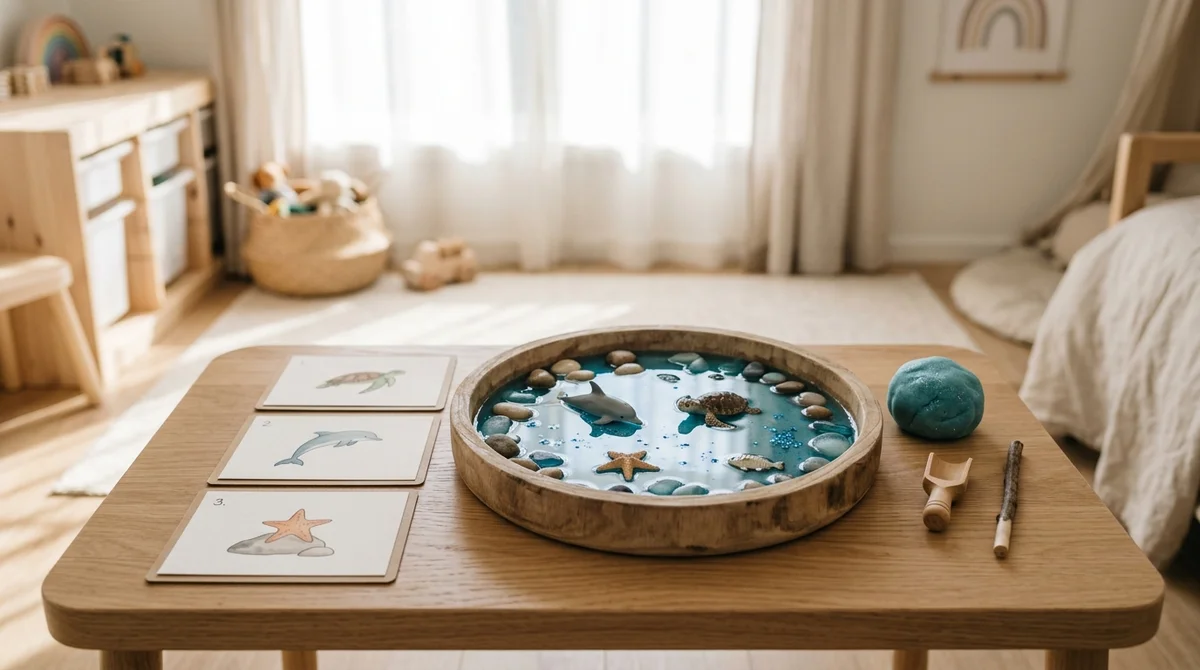 Figure: A structured sensory play setup—featuring visual sequence cards, natural water basins, and tactile materials—bridges concrete exploration into imaginative storytelling.
Activity 1: The Outdoor Mud Kitchen & Patisserie
- The Sensory Foundation: Provide potting soil, clean water, smooth pebbles, pine needles, dry leaves, varied mixing bowls, wooden spoons, whisks, and silicone muffin tins outdoors. This medium delivers rich tactile, olfactory, and proprioceptive inputs.
- The Imaginative Bridge: Frame the mud-mixing area as an artisanal bakery or soup cafe. Begin by validating the physical properties of the medium: “This mud is thick, heavy, and cold.” Then, introduce symbolic substitution: “Let’s scoop this thick mixture into the muffin tray to bake chocolate pies for the woodland bears.”
- Scaffolding Technique: Offer concrete visual menu cards with pictures:
- Scoop two cups of mud.
- Stir in three pinecones.
- Bake in the sunny spot for ten seconds.
- Serve to the toy rabbit.
- This structure anchors the narrative in physical manipulation, giving abstract roleplay a clear, cause-and-effect foundation.
Activity 2: Sensory Ocean Trays & Rescue Quests
- The Sensory Foundation: Fill a shallow plastic storage bin with clean sand on one side and cool water colored with a few drops of blue food dye on the other. Add real sea shells, smooth river stones, and realistic aquatic animal figures.
- The Imaginative Bridge: Instead of leaving the bin completely open-ended, introduce a focused narrative mission. Set up a scenario where an ocean creature encounters an obstacle: “The sea turtle is swimming through the deep water, but a storm washed these pebbles across the cave entrance. He needs our help to clear a path so he can rejoin his family on the dry sand.”
- Scaffolding Technique: Encourage your child to run their hands through the cool water and sift the sand through their fingers. The rich physical inputs ease anxiety, allowing them to project intent and emotional states onto the animal figures as they resolve the challenge.
Activity 3: Scented Memory Playdough Storytelling
- The Sensory Foundation: Prepare batches of homemade modeling dough, scenting each with safe culinary extracts: lemon zest in one, ground cinnamon in another, and fresh peppermint in the third.
- The Imaginative Bridge: The olfactory system connects directly to the brain’s limbic system and hippocampus, which govern emotion and associative memory. Use these distinct scents to anchor specific characters or imaginary locations.
- Scaffolding Technique:
- The yellow lemon dough represents a warm, sunlit desert planet.
- The brown cinnamon dough represents an ancient gingerbread forest.
- The white peppermint dough represents a freezing arctic mountaintop.
- Have the child sculpt elements corresponding to each scent: “Can you roll three icy peppermint boulders to shield our basecamp from the wind?” This pairs tactile manipulation with multisensory world-building.
Activity 4: Storytime Slime & Character Sensory Immersion
- The Sensory Foundation: Make an elastic, non-sticky sensory gel using cornstarch, warm water, and safe craft colors. Pair this with swatches of contrasting textiles: faux fur, coarse burlap, smooth silk, and textured bubble wrap.
- The Imaginative Bridge: Use these tactile mediums alongside reading an illustrated adventure book. Rather than simply reading text from a page, connect narrative events to immediate sensory experiences.
- Scaffolding Technique: When the book’s protagonist trudges through a marsh, invite your child to press their fingers into the cool slime to experience how heavy the character’s boots feel. When the character dons a protective winter coat, wrap their shoulders in the faux fur. This concrete approach translates abstract story elements into physical sensations, grounding comprehension and empathy.
Activity 5: Bathtub Pouring Laboratory & Potion Mixing
- The Sensory Foundation: Use warm bathwater, clear plastic squeeze bottles, measuring cups, clear funnels, and natural food coloring tablets. The warm water provides soothing vestibular and proprioceptive input across the body.
- The Imaginative Bridge: Frame the simple act of pouring and transferring water as an advanced scientific laboratory or an alchemist’s magic workshop.
- Scaffolding Technique: Give your child visual formula cards detailing cause-and-effect steps:
- “Add two scoops of blue fuel to one scoop of yellow fuel.”
- Watch the colors shift to bright green.
- “The rocket fuel is ready! Pour it into the main thruster bottle to launch the starship.”
- This format transforms repetitive water play into a creative scenario with clear narrative goals.
Section 4: Step-by-Step Home Strategies to Encourage Pretend Play
If you are looking for practical guidance on how to encourage imaginative play in autism, open-ended prompts like “Go pretend” will almost always trigger anxiety and withdrawal. Instead, use these four systematic strategies to bridge the gap between concrete thinking and creative expression.
┌────────────────────────────────────────────────────────────────────────┐
│             4-STEP HOME STRATEGY FOR SCAFFOLDING PLAY                  │
├────────────────────────────────────────────────────────────────────────┤
│  STRATEGY 1: HARNESS SPECIAL INTERESTS                                 │
│  (Anchor scenarios in existing hyperfixations for motivation)          │
│         │                                                              │
│         ▼                                                              │
│  STRATEGY 2: PRACTICE PREDICTABLE MICRO-SKITS                          │
│  (Run 2-to-3-minute real-world scripts with clear boundaries)          │
│         │                                                              │
│         ▼                                                              │
│  STRATEGY 3: INTEGRATE VISUAL STORYBOARDS                              │
│  (Turn abstract narrative arcs into concrete, visual flowcharts)       │
│         │                                                              │
│         ▼                                                              │
│  STRATEGY 4: TRANSITION FROM BUILDING TO STORY                         │
│  (Use construction toys as narrative stage sets)                       │
└────────────────────────────────────────────────────────────────────────┘
4.1 Strategy 1: Harness Special Interests
A child’s special interests (hyperfixations) are their greatest developmental asset. Rather than trying to redirect your child toward “standard” toys, treat their deep interests as the core fuel for imaginative play.
When you incorporate a child’s passions, you bypass task resistance and tap into powerful intrinsic motivation:
- If their interest is Trains: Do not force a tea party with teddy bears. Instead, host a tea party inside the dining car of the express locomotive. Have the trains transport ingredients, schedule passenger arrival times, or manage a mechanical breakdown on the tracks.
- If their interest is Household Appliances: Turn vacuum cleaners into space expedition vehicles clearing space dust from alien planets, or set up a fictional repair shop where different animals bring broken toasters to be serviced.
- If their interest is Astronomy: Turn the hallway into an interplanetary exploration route, transforming dining room chairs into command modules that navigate through asteroid fields.
By respecting their focus, you demonstrate that their inner world is valued, making them far more willing to try new play variations.
4.2 Strategy 2: Practice Micro-Skits
Spontaneous roleplay often feels overwhelming because children do not know what is expected of them or when the activity will end. To make this manageable, break pretend play down into structured “micro-skits”—predictable scenarios that last just two to three minutes.
- Select an Everyday Scenario: Choose simple, familiar transactions like ordering an ice cream cone, visiting a shoe store, or checking out a library book.
- Assign Explicit Roles: Clearly define who everyone is playing: “I will be the shopkeeper behind the table, and you will be the customer looking for mint chocolate chip.”
- Provide Concrete Dialogue Scripts: Give the child predictable lines to speak or point to on an augmentative communication board:
- Parent: “Welcome to my shop! What flavor would you like?”
- Child: “One scoop of vanilla, please.”
- Parent: “Here is your scoop! That will be one gold coin.”
- Child: “Thank you. Goodbye!”
- Introduce Mild Plot Twists: Once your child masters the basic script and feels secure, gently introduce a single variable: “Oh no, we are completely out of vanilla! Would you like chocolate, or should we walk to the next shop?” This step introduces flexibility, narrative tension, and creative problem-solving within a predictable framework.
4.3 Strategy 3: Integrate Visual Aids & Story Cards
Autistic learners generally process visual information far more effectively than transient auditory instructions. Abstract story structures become accessible when translated into physical, visual layouts.
┌──────────────┐      ┌──────────────┐      ┌──────────────┐
│  CARD 1:     │  ──► │  CARD 2:     │  ──► │  CARD 3:     │
│  The Problem │      │  The Journey │      │ The Solution │
└──────────────┘ └──────────────┘ └──────────────┘- Use Visual Graphic Organizers: Print or sketch three simple, sequential panels labeled Beginning, Middle, and End.
- Create Concrete Story Cards: Use illustrated flashcards depicting simple situations:
- Card 1 (Beginning): A small puppy is caught on top of a wall.
- Card 2 (Middle): A fire engine drives through the town with ladders.
- Card 3 (End): The puppy is back on the ground, happily eating a treat.
- Walk Through the Sequence: Lay these visual cards on the floor like a roadmap. Guide the child to manipulate the toy vehicles and figurines according to the visual map. This provides clear narrative structure, turning ambiguous make-believe into an achievable, structured mission.
4.4 Strategy 4: Transition from Building to Storytelling
Many autistic children show remarkable spatial ability, focus, and dexterity with construction mediums like Lego bricks, magnetic tiles, wooden train tracks, or fort-building kits. Leverage these structural strengths as an on-ramp to pretend play.
- Honor the Construction Phase First: Allow the child to invest significant time building an elaborate, structurally sound environment—a multi-story garage, an animal habitat, or a fortified fortress. Validate their engineering focus.
- Populate the Environment: Once construction is complete, introduce miniature inhabitants: “This fortress has high walls! Who works here to protect the base?” Place two figurines at the gate.
- Prompt the Narrative Arc: Use functional prompts to initiate plot: “The sun is setting over the castle. Where do these two guards go to rest?” or “A severe snowstorm is approaching your building; how can we protect these miniature animals inside?”
By treating construction as the theatrical stage, the child naturally shifts from physical builder to narrative director.
Section 5: Tailoring Activities Across Support Needs
Autism is a diverse spectrum; what delights and supports one child may overwhelm or frustrate another. To ensure success, adapt imaginative play to your child’s specific developmental and communication profile.
5.1 Activities for Higher-Support Learners
For children who have significant communication challenges, motor planning delays, or high sensory support needs, activities must be tactile, concrete, and free of complex verbal demands.
- Non-Verbal Tactile Story Sculpting: Use soft modeling clay, water tables, or finger paints. Instead of demanding spoken dialogue, join them in parallel play by rolling a ball of clay alongside them, stamping toy dinosaur footprints across the dough, and making playful vocalizations (“Stomp, stomp, roar!”). This establishes joint attention and symbolic representation without verbal pressure.
- Visual Choice Board Storytelling: As detailed in our guide on how to use AAC with your child at home, use Picture Exchange Communication System (PECS) cards or communication apps to direct play. Provide choices:
- “Who goes on the train?” (Child selects card: Elephant)
- “Where does the elephant go?” (Child selects card: Swimming pool)
- “What happens next?” (Child selects card: Big Splash!)
- Act out their selections immediately. This teaches the child that their visual choices have direct, imaginative consequences in physical reality.
- Music and Somatic Movement Enactment: Pair rhythmic instruments (drums, bells, shakers) with animal characterizations. Play slow, heavy drum beats while lumbering across the carpet like a bear, then switch to fast, light shaker sounds to flutter around like an insect. This channels imaginative roles through vestibular and proprioceptive movement rather than abstract language.
5.2 Activities for Lower-Support Learners
Children who possess fluent spoken language often require scaffolds that target executive function, social nuance, and perspective-taking, matching their analytical capabilities.
- World-Building, Map-Making, and Sci-Fi Chronicles: Encourage your child to draft detailed geographical maps, design flags, invent languages, or write out technical manuals for an imaginary alien planet. This approach honors their passion for detail while developing deep, imaginative narrative worlds.
- Collaborative Tabletop Role-Playing Games (TTRPGs): Modified tabletop games like Dungeons & Dragons provide structured, rule-governed roleplay. These games offer an ideal balance for autistic minds: they operate on clear rulebooks, mathematical dice rolls, and explicit statistical bounds, while challenging players to adopt a character persona, navigate moral quandaries, and solve creative narrative puzzles.
- Structured Drama Skits and Video Production: Encourage the child to write, stage, and film short video skits or stop-motion animations using their favorite figurines. Using a camera lens offers a safe, comfortable distance: the child can direct, edit, and plan creative stories systematically, developing perspective-taking without the stress of real-time improvisation.
Section 6: Frequently Asked Questions (FAQ)
Is lack of imagination a symptom of autism?
No. A complete lack of imagination is not a defining symptom of autism. While clinical diagnostic manuals highlight differences in how autistic individuals engage in spontaneous, open-ended social pretend play, this reflects a difference in expression rather than an absence of capacity. Autistic individuals possess rich imaginative minds, but they tend to express creativity through structured systems, deep visual thinking, technical world-building, and special interests rather than traditional, unscripted social roleplay.
How does autism impact imaginative play in children?
Autism shapes imaginative play by fostering a preference for predictability, concrete logic, and consistency. Traditional pretend play is typically ambiguous, unscripted, and reliant on interpreting fast-moving social cues—elements that can overload an autistic child’s nervous system. As a result, autistic play frequently presents as structured, repetitive, or literal (such as lining up toys or reenacting familiar media scripts). These play patterns provide necessary self-regulation and cognitive stability, serving as an orderly foundation from which creativity can emerge when proper visual and sensory scaffolding is provided.
How can parents support imagination in an autistic child?
Parents can nurture imagination by connecting pretend play directly to their child’s special interests, avoiding the urge to force generic play patterns. Introducing multisensory mediums—like outdoor mud kitchens, textured sensory trays, scented playdough, or water pouring stations—grounds the child’s nervous system and makes symbolic substitution accessible. Breaking play down into short, two-minute “micro-skits” with clear scripts and using visual aids (such as storyboards and picture cards) provides the predictable structure autistic children need to explore creative scenarios with confidence.
Moving Forward: Expanding Your Child’s World
Noticing that your child interacts with toys differently than their neurotypical peers is not a sign of a barren imagination. Their creative world is not missing; it is simply waiting for a neuro-affirming key.
┌────────────────────────────────────────────────────────────────────────┐
│                   YOUR 3-STEP ACTION PLAN FOR TODAY                    │
├────────────────────────────────────────────────────────────────────────┤
│ 1. OBSERVE WITHOUT INTERRUPTING: Find the sensory properties your      │
│    child loves most (spinning wheels, arranging lines, tactile touch). │
│                                                                        │
│ 2. LOWER DEMANDS: Replace open-ended questions ("What should we do?")  │
│    with a concrete micro-skit or sensory bin.                          │
│                                                                        │
│ 3. ENTER THEIR WORLD FIRST: Join their preferred play pattern before   │
│    introducing a single imaginative variable.                          │
└────────────────────────────────────────────────────────────────────────┘
You do not need to overhaul your child’s entire play routine overnight. Real developmental progress occurs through quiet, consistent, and patient scaffolding.
Start today by selecting one small, low-stress strategy:
- Introduce a single textured prop into your evening book reading.
- Set up a small water basin with two plastic sea creatures.
- Or sit quietly beside your child on the rug, line up a row of cars alongside them, and gently introduce a toy figurine who stops to admire the beautiful, orderly line they created.
When we meet autistic children where they are, honor their processing styles, and supply the sensory and visual structures they need, their imaginative worlds can flourish on their own terms.