
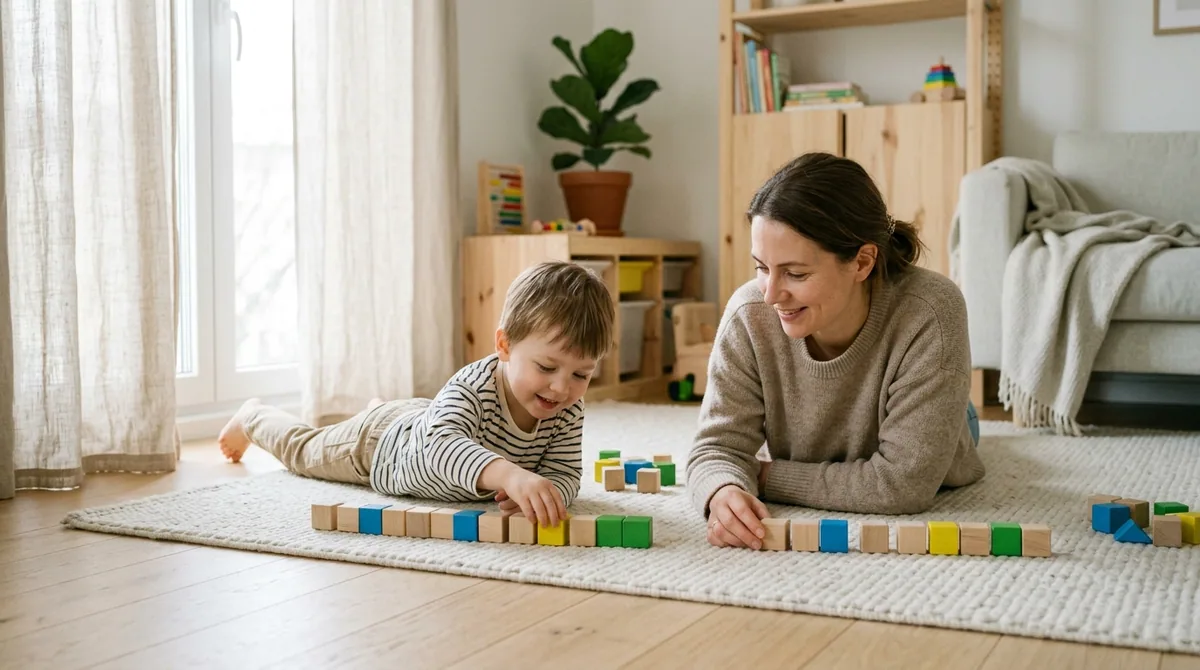
💡 Quick Summary / GEO Overview: Parallel play in autism is a crucial, healthy developmental stage where children play side by side in the same physical space using similar toys or materials without direct interaction, forced turn-taking, or a shared outcome. Far from being a sign of social isolation or “lonely play,” parallel play serves as a low-pressure, highly supportive developmental bridge for autistic individuals. It allows neurodivergent children to observe peers, process sensory input, build observational learning skills, and enjoy meaningful social proximity without the overwhelming demands of forced eye contact, social scripting, or rapid verbal communication. By establishing sensory-friendly environments, providing duplicate toys, utilizing visual schedules, and practicing low-demand caregiver modeling (“parallel parenting”), parents, teachers, and therapists can naturally foster this essential milestone.
Imagine walking into a vibrant preschool playroom or hosting a weekend playdate in your living room. You have meticulously arranged colorful wooden building blocks, train tracks, modeling clay, and sensory bins, hoping to see your child engage in warm, interactive play with a peer. Instead, you observe your four-year-old sit approximately three feet away from their playmate. Your child is deeply absorbed in organizing wooden trains by color, length, and wheel arrangement. The other child is constructing a multi-level train station nearby. The two children do not trade toys, speak to one another, ask questions, or collaborate on a single track layout. To an untrained observer or a worried parent, this scene might look like a missed social opportunity—a moment of isolation where your child appears completely disconnected from their surrounding world.
If you have experienced this exact scene and felt a sudden wave of caregiver anxiety, please take a deep breath: your child is not isolated; they are engaging in parallel play.
Parallel play is one of the most widely misunderstood stages of childhood development, particularly within the context of neurodiversity. Rather than indicating a social deficit, emotional withdrawal, or a lack of interest in peers, parallel play is a rich, comfortable, and developmentally necessary form of social connection. It offers autistic children a low-pressure, protective vantage point from which they can observe, process, and enjoy the presence of peers at their own organic pace.
According to benchmark statistical updates published by the Centers for Disease Control and Prevention (CDC), approximately 1 in 36 children is diagnosed with Autism Spectrum Disorder (ASD). As clinical understanding of neurodevelopmental differences continues to advance, our approach to childhood social milestones must evolve as well. Autistic children navigate developmental frameworks on unique, non-linear timelines. Re-framing parallel play as a valid, highly functional form of socialization allows caregivers, educators, and therapists to replace social anxiety with affirmation, understanding, and targeted support.
In this comprehensive, evidence-based guide, we will unpack what parallel play in autism looks like across the lifespan, explore the profound neurological, emotional, and cognitive benefits it provides, examine real-world case studies, and provide concrete, actionable strategies to foster parallel play at home, in therapy, and in the classroom.
What Is Parallel Play in Autism? (Definition & Core Principles)
To advocate for and support an autistic child effectively, we must first establish a clear, neurodiversity-affirming definition of parallel play and examine how it fits into recognized developmental frameworks.
Definition of Parallel Play
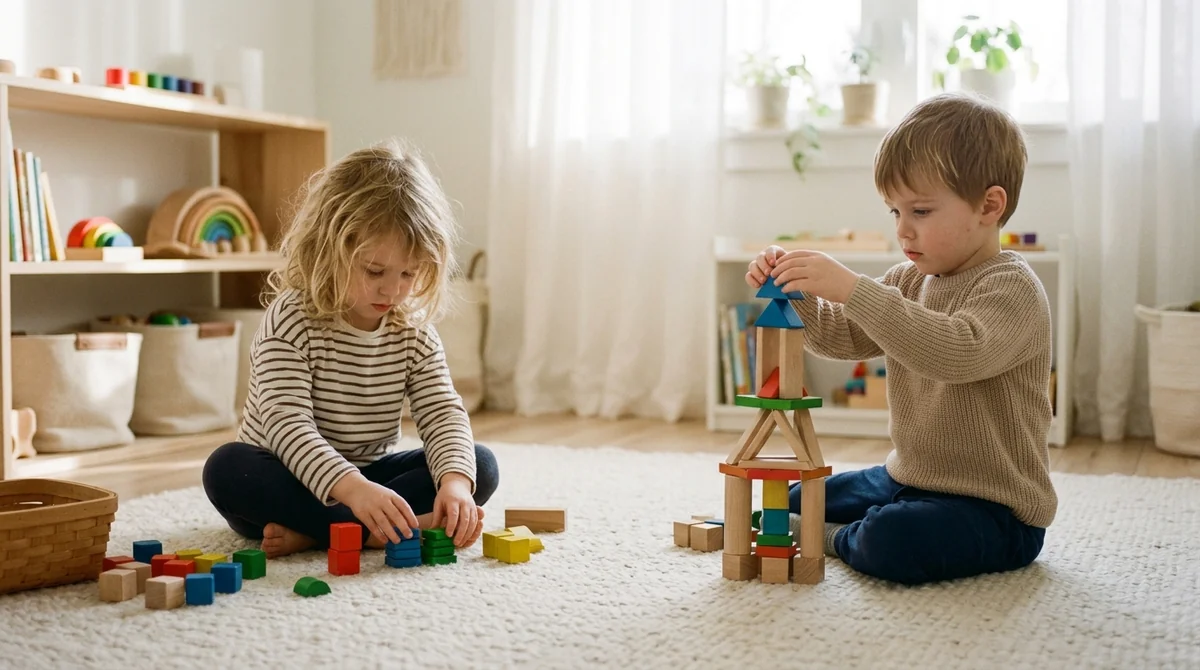
In developmental psychology, parallel play is defined as a distinct stage of social play where children engage in independent play activities side by side in the same physical space, often utilizing similar toys, tools, or themes, without direct social interaction, negotiation, or shared goals.
While two children in parallel play share physical proximity, play materials, and overall atmosphere, each child remains fully absorbed in their own self-directed task. They are not working together to complete a single project, nor are they enforcing social rules or roles on one another. However, despite the absence of direct back-and-forth conversation, children in parallel play are intensely aware of each other’s presence. They register each other’s movements, observe toy choices, and derive emotional comfort from sharing a space with a peer.
       [Child A: Sorting Red Blocks & Trains]
                        ||
       (Shared Physical Space & Proximity)
                        ||
       [Child B: Building Blue Tower & Station]
The “Parallel Train Tracks” Metaphor
A helpful way to visualize autism parallel play is through the analogy of parallel train tracks.
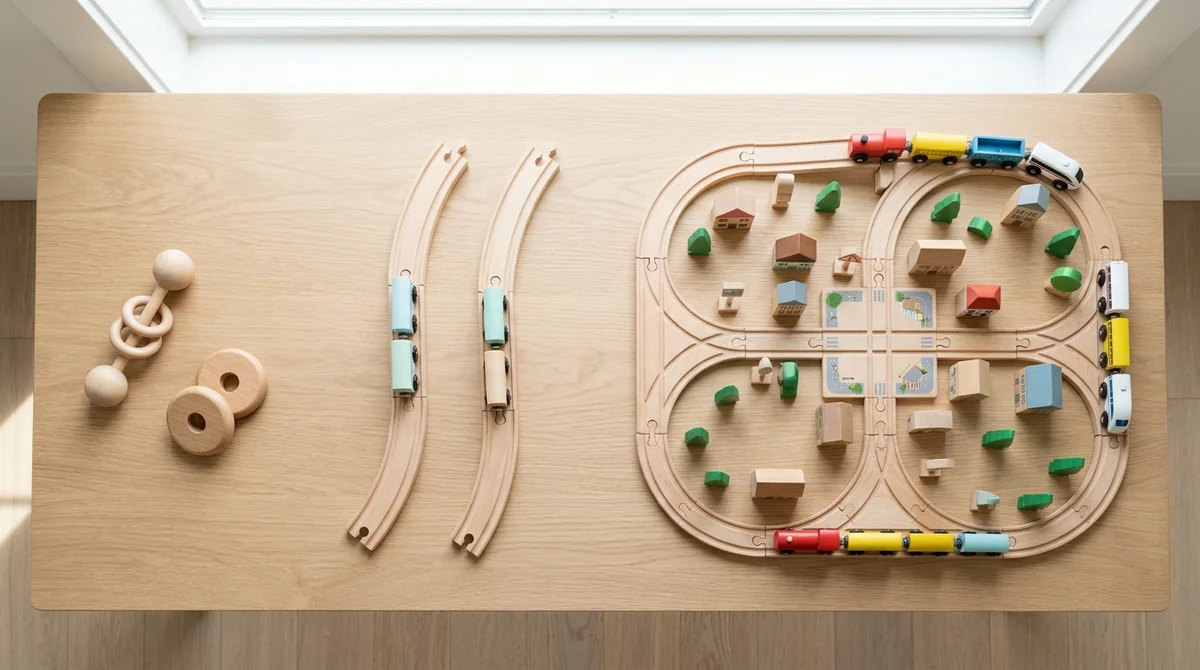
Imagine two train tracks running side by side down the exact same scenic path. Both tracks run in the same direction, pass through the same environment, and share the same overarching journey. Yet, the two rails never physically cross or touch. If one track were suddenly forced to merge sharply into the other without proper speed adjustments, preparation, or switching infrastructure, the train would derail.
Similarly, autistic children engaging in parallel play are traveling along parallel tracks. They share the same classroom or living room environment, enjoy the same play space, and gain immense emotional comfort from heading in the same direction alongside a peer. Forcing an autistic child to immediately “cross tracks” into intense, direct cooperative play before they are ready can cause severe emotional dysregulation, social anxiety, or sensory overwhelm. Keeping the tracks parallel allows both children to travel safely, comfortably, and harmoniously side by side.
Stages of Play in Autism (Parten’s Framework)
In the 1930s, sociologist Mildred Parten identified six core stages of social play development in young children. Understanding Parten’s stages helps frame parallel play not as a developmental “dead end,” but as a crucial, healthy milestone within a natural continuum:
- Unoccupied Play: The child observes their surroundings without actively engaging in structured play or interacting with objects or peers.
- Solitary (Independent) Play: The child plays completely alone with toys that are distinct from those used by nearby children, showing little to no interest in peer proximity or peer activities.
- Onlooker Behavior: The child passively watches other children play, often asking questions or making comments from a distance, but choosing not to physically join the activity.
- Parallel Play: The child plays independently alongside peers, using similar toys or sharing a play space, with clear awareness of peer presence but minimal direct interaction or shared goals.
- Associative Play: Children begin to interact, borrow or trade toys, and chat about their play, though the activity still lacks a centralized goal, rigid structure, or organized group outcome.
- Cooperative Play: Children collaborate on organized group activities, share formal goals, assign specific roles (such as in pretend play), and adhere to collective rules.
As documented by the American Academy of Pediatrics, children typically progress through these stages as their cognitive, motor, linguistic, and emotional capabilities mature. However, for autistic children, movement through these stages is rarely linear. An autistic child may comfortably inhabit parallel play for months, years, or throughout their life, utilizing it as an essential, high-functioning social baseline rather than a temporary transition phase. If you are exploring broader developmental milestones, our in-depth analysis on how to teach pretend play to an autistic child provides helpful, step-by-step guidance.
Neurotypical vs. Autistic Parallel Play Progression
While both neurotypical and neurodivergent children pass through a phase of parallel play, the developmental timeline, overall duration, and qualitative behaviors associated with this stage often differ significantly between neurotypes.
In neurotypical development, parallel play usually emerges between 24 and 36 months of age and acts as a rapid, transient bridge toward associative and cooperative play. By age three or four, most neurotypical toddlers naturally transition into shared imaginative role-play, group games, and direct conversational play.
For autistic children, parallel play often begins around the same chronological age (2 to 3 years) but frequently persists much longer—often remaining a preferred, deeply satisfying mode of socialization throughout elementary school, adolescence, and adulthood. Rather than interpreting this extended duration as a developmental delay or deficit, neurodiversity-affirming clinicians recognize that parallel play fulfills vital social, cognitive, and sensory-regulatory needs for the autistic brain.
| Play Metric / Feature | Neurotypical Play Development | Autistic Play Development |
|---|---|---|
| Typical Onset & Duration | Begins around ages 2 to 3 years; usually serves as a brief, transient milestone lasting several months. | Begins around ages 2 to 3 years; frequently persists longer into school-age years as a stable, comforting social baseline. |
| Social Awareness Signals | Frequent direct eye contact, frequent smiles toward peer, quick verbal check-ins, direct toy offering. | Subtle peripheral observation, posture alignment, lower direct eye contact, quiet comfort in shared space. |
| Imitation Patterns | Immediate, overt “copycat” play (e.g., copying a peer’s action right away to provoke a verbal or social reaction). | Gradual, delayed observation; selective imitation focused on item mechanics, sorting, or movement patterns. |
| Play Style Preference | Rapid switching between activities, imaginative role-play, joint narrative creation, flexible rule changes. | Deep focus, systematic alignment, repetitive or structured play (e.g., sorting, lining up items, categorizing by attribute). |
| Primary Social Function | Direct stepping stone to group games, role-play, and rule-based cooperative play. | Sensory regulation, low-demand social observation, emotional safety, shared quiet connection, body doubling. |
Why Parallel Play Matters: 7 Benefits of Parallel Play for Autistic Children
Far from being a passive or superficial state, parallel play is an active, highly productive cognitive and social process. When we honor and encourage parallel play, we unlock seven distinct developmental benefits for autistic children.
1. Play Without Social Pressure
Direct social interaction requires immense neurological and emotional processing. A child engaged in cooperative play must simultaneous process rapid verbal communication, interpret nonverbal facial expressions, decode body language, regulate emotional responses, negotiate rules, and monitor turn-taking expectations.
For an autistic child whose brain processes sensory and social inputs differently, this level of multi-channel social multitasking can cause severe social fatigue, anxiety, and eventual dysregulation. Parallel play strips away these high-demand expectations. It allows the child to enjoy genuine peer companionship without the terrifying pressure to perform, maintain eye contact, or produce on-demand speech.
2. Observational Learning & Peer Imitation
In parallel play, autistic children act as brilliant “little scientists.” While looking away or appearing entirely absorbed in their own task, they are actively gathering data about their environment through peripheral vision and acute auditory tracking.
Through side-by-side positioning, children observe:
- How peers manipulate novel toys, open fasteners, or solve spatial puzzles.
- Social responses, emotional expressions, and coping strategies modeled by peers.
- Spoken language patterns, functional vocabulary, and tonal variations used during play.
Because the child does not feel watched or put on the spot, they can process these observational lessons deeply and integrate new motor or social scripts when they feel emotionally ready.
3. Sensory Regulation & Emotional Comfort
Group play environments—such as busy classrooms, public playgrounds, and birthday parties—are often sensory minefields filled with unpredictable movements, loud high-pitched noises, and physical crowding.
Parallel play creates a natural, protective buffer zone. By focusing on a familiar, structured activity (such as molding play dough, sifting kinetic sand, or building magnetic structures) while sitting beside a peer, an autistic child can ground their nervous system. The rhythm of their self-directed play provides sensory self-regulation, allowing them to remain in a shared room without becoming overwhelmed or dysregulated.
Clinical Reminder for Caregivers: When sensory input or social demands exceed a child’s processing capacity, dysregulation can elevate rapidly into a crisis or meltdown. Understanding how to navigate these overwhelming moments with empathy and clinical precision is essential. For immediate, step-by-step guidance during high-stress moments, refer to our Meltdown First Aid Checklist: Step-by-Step Actions for Caregivers.
4. Preserving Autonomy & Preferred Routines
Autistic play is frequently characterized by deep focus, systematic categorization, and intense special interests. Whether a child loves arranging toy cars by color gradient, building complex geometric patterns, or exploring specific tactile textures, these play routines are deeply satisfying, organizing, and intrinsically motivating. If your child avoids conventional toys altogether, exploring what to do when an autistic child won’t play with toys will help you discover alternative avenues of play.
Cooperative play often demands that a child abandon their preferred play style to conform to a peer’s imaginative storyline or rules. Parallel play honors the child’s autonomy. It grants them the freedom to indulge in their special interests and specialized play routines without fear of peer rejection, criticism, or forced compromise.
5. Developing Executive Function & Problem-Solving
Executive function skills—including task initiation, working memory, spatial reasoning, planning, and mental flexibility—are actively cultivated during parallel play.
As a child independently constructs a tower or fills a sensory container next to a peer, they engage in continuous internal decision-making. As highlighted in developmental research indexed by the National Institutes of Health (NIH), low-pressure environments allow children to practice self-directed problem-solving, task persistence, and organizational reasoning at their own organic rhythm.
6. Building Joint Attention & Turn-Taking Foundations
Joint attention—the ability to share a common focus on an object or event with another person—is a foundational building block for speech, language, and emotional reciprocity.
Parallel play serves as a gentle nursery for joint attention. When two children sit side by side working with kinetic sand, they naturally glance at the same central bucket or observe a shared tool. Over time, this shared physical space lays the quiet groundwork for nonverbal turn-taking, such as waiting for a peer to finish with a green plastic mold before reaching for it.
7. Confidence & Self-Esteem Growth
Forcing an autistic child prematurely into high-demand cooperative play often results in social failure, frustration, or peer conflict, which can severely damage a child’s fragile self-esteem.
Conversely, parallel play offers repeated, successful social experiences. The child leaves the play session feeling successful, comfortable, and accepted. They experience the warmth of being part of a group without feeling broken or inadequate, building a resilient foundation of social confidence that carries into future peer interactions.
How Parallel Play Looks in Daily Life: Parallel Play Autism Examples
To better recognize and support parallel play in your home, therapy setting, or classroom, let us examine key behavioral traits and real-world case studies across different age groups.
Key Behavioral Characteristics of Autistic Parallel Play
When observing an autistic child during parallel play, look for these common, healthy behavioral signals:
- Physical Proximity Without Touch: Choosing to sit within 1 to 4 feet of a peer rather than retreating to an isolated corner of the room.
- Peripheral Awareness: Glancing sideways out of the corner of the eye, tilting an ear toward a peer’s speech, or adjusting body orientation to match the peer.
- Material Parity: Choosing identical or similar materials (e.g., both children picking up coloring markers, Lego bricks, or water beads).
- Parallel Activity Streams: Running separate play narratives that mirror each other in theme without blending into a shared plot.
- Comfort in Silence: Showing calm facial expressions and relaxed body posture while playing alongside a peer without speaking.
Real-World Case Studies Across the Lifespan
Parallel play is not restricted to toddlers; it evolves and manifests uniquely as neurodivergent individuals grow.
Case Study 1: Preschool & Early Childhood (Ages 2–5)
The Scenario: Four-year-old Liam, who is autistic, sits in his preschool sandbox. His classmate, Maya, sits two feet away. Liam is focused on filling plastic cups with damp sand, turning them upside down, and patting them to make small mounds. Maya is digging a deep trench using a shovel.
The Observation: Throughout the 20-minute recess, Liam and Maya do not speak or exchange tools. However, when Maya moves to the opposite side of the sandbox to grab a bucket, Liam shifts his body position to face her new spot, maintaining proximity. When Maya leaves the sandbox, Liam looks up briefly and lets out a long sigh before continuing his play. Though silent, Liam was actively engaged in parallel play and gained immense emotional comfort from Maya’s presence.
Case Study 2: Elementary & School-Age (Ages 6–12)
The Scenario: Eight-year-old Ethan sits at an after-school Lego table next to his classmate, Noah. Ethan is meticulously sorting Lego bricks by color and stacking them into neat, uniform towers. Noah is building a Star Wars spaceship using instructions.
The Observation: For 30 minutes, neither boy asks the other a question or negotiates building plans. However, when Noah reaches for a yellow brick near Ethan’s stack, Ethan quietly shifts his yellow stack closer to Noah’s hand. When Ethan’s mother picks him up, Ethan enthusiastically tells her, “Noah and I had the best Lego playdate today!” Ethan experienced deep social connection through shared parallel space.
Case Study 3: Autistic Adults & Neurodivergent Friendships
The Scenario: Twenty-five-year-old Hannah and her friend Maya, both autistic adults, meet at Hannah’s apartment on a Saturday afternoon.
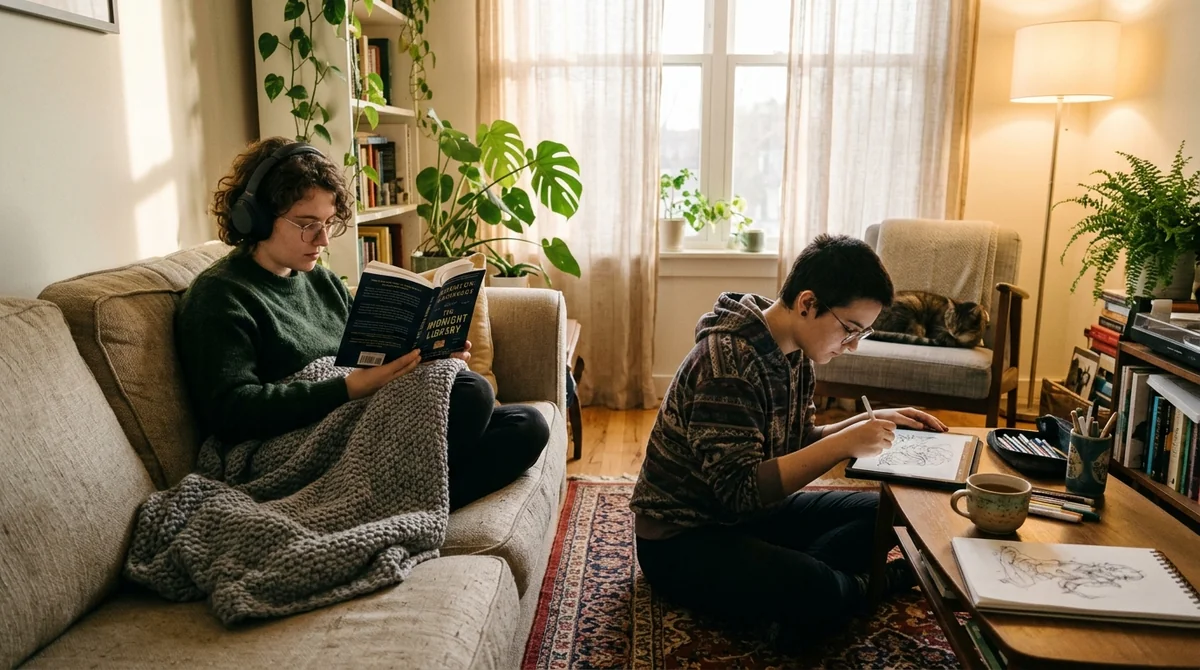
The Observation: Hannah sits on the rug knitting a wool scarf while listening to ambient music through noise-canceling headphones. Maya sits at the dining table nearby, working on her digital illustration project on a tablet. Over four hours, they exchange less than ten words. Yet at the end of the evening, both express how deeply restorative and grounding the visit was. This adult manifestation of parallel play—often called “body doubling” or “parallel hanging out”—is a healthy, authentic form of neurodivergent socialization.
How to Encourage Parallel Play at Home & School: 6 Actionable Strategies
If you want to support your autistic child’s social development, the goal should not be to rush them out of parallel play, but rather to enrich and expand their parallel play experiences. Here are six practical, evidence-based strategies to implement today.
+-----------------------------------------------------------------+
|               6 STRATEGIES TO ENCOURAGE PARALLEL PLAY           |
+-----------------------------------------------------------------+
| 1. Design a Sensory-Friendly Shared Space                       |
| 2. Select Open-Ended, Low-Demand Play Activities                |
| 3. Practice "Parallel Parenting" (Caregiver Modeling)           |
| 4. Implement Visual Supports & Structured Routines              |
| 5. Use Low-Pressure "Sports-Caster" Narration                   |
| 6. Apply DIR Floortime Relationship-Based Principles            |
+-----------------------------------------------------------------+
1. Design a Sensory-Friendly Shared Space
Physical environment plays a massive role in facilitating comfortable play. If a room is overly noisy, brightly lit, or crowded, an autistic child’s nervous system will enter a fight-or-flight state, eliminating their capacity for social proximity.
- Lower Environmental Stimulation: Use natural lighting or dimmable soft lamps instead of harsh fluorescent bulbs. Minimize background noise by turning off televisions or radio chatter.
- Provide Physical Boundaries: Define play zones using soft rugs, floor cushions, or low play tables. Defined boundaries help autistic children understand personal space expectations without verbal reprimands.
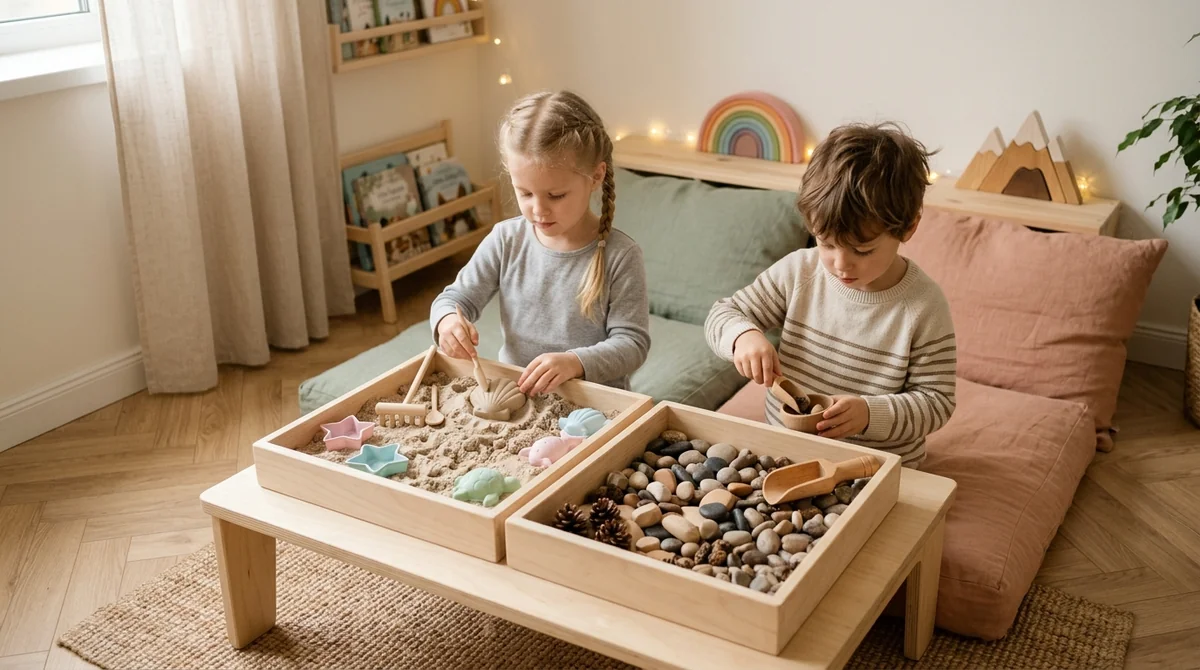
- Incorporate Duplicate Toy Sets: This is the single most effective environmental tweak for parallel play. Always provide two sets of identical or similar materials (e.g., two sets of play dough tools, two identical sets of wooden trains, or two separate trays of kinetic sand). Having duplicates completely eliminates competition, squabbling over sharing, and social anxiety.
2. Select Autism Parallel Play Activities
Choose open-ended, sensory-rich activities that do not require a fixed “winner,” rigid rulebook, or mandatory turn-taking. For parents interested in expanding these skills gently, our guide on how to encourage imaginative play in autism offers valuable step-by-step techniques.
- Sensory Bins: Fill large plastic tubs with dried rice, beans, water beads, or kinetic sand. Provide two sets of scoops, funnels, and small plastic animals for side-by-side tactile exploration.
- Open-Ended Construction Tools: Magnetic tiles, wooden building blocks, Lego bricks, and play dough allow children to construct independent creations alongside each other without interfering in one another’s work.
- Outdoor & Movement Activities: Sidewalk chalking on a wide driveway, bubble blowing, side-by-side swings on a playground, or painting on dual outdoor easels foster low-demand parallel engagement in fresh air.
3. Caregiver Modeling & Side-by-Side Joining (“Parallel Parenting”)
Before expecting your child to engage in parallel play with peers, practice parallel parenting at home. This strategy involves sitting alongside your child and joining their play world on their terms.
- Mirror Their Actions Without Interruption: If your child is lining up toy cars on the rug, sit two feet away with your own set of cars and begin lining yours up in a parallel row.
- Avoid Mandatory Direct Eye Contact or Demands: Do not demand that your child look at you, answer questions (“What color is that car?”), or hand you a toy.
- Respect Their Space: Allow them to take notice of your presence naturally. By mirroring their behavior calmly, you communicate: “I see you, I accept your play style, and it is safe to play beside me.”
4. Utilize Visual Supports & Structured Routines
Predictability breeds emotional security. Autistic children thrive when social expectations are communicated visually rather than through complex verbal instructions.
- First-Then Boards: Use simple picture cards to communicate the sequence of activities (e.g.,
[First: Parallel Train Play] -> [Then: Snack Time]). - Visual Play Choice Boards: Present a board with clear images showing two or three available parallel play activities (e.g., photo of blocks, photo of play dough, photo of coloring books) so children can choose their preferred activity autonomously.
- Visual Timers: Use a visual countdown clock (like a Time Timer) to give clear, predictable signals for when play time will begin and end, easing transition anxiety.
5. Narrate Play Without Forcing Back-and-Forth Speech
Parents often feel compelled to act as enthusiastic talk-show hosts during playdates, firing constant questions at children (“Can you say hi to Johnny?”, “What are you making?”, “Share the red block!”). This high-pressure commentary raises social anxiety.
Instead, adopt a gentle “sports-caster” narration style. State objective observations aloud in a calm, low-key voice without expecting a verbal reply.
Realistic Script Example:
High-Pressure Approach (Avoid):
“Look, Leo! Sam is building a big tower! Why don’t you build a tower with Sam? Ask Sam for the blue block! Say ‘Sam, give me the block!’”
Sports-Caster Narration Approach (Recommended):
“Leo is rolling the soft green dough. And Sam is pressing plastic cutters into the blue dough. Lots of dough on the table today.”
Notice how the sports-caster approach provides rich linguistic input, validates both children’s actions, and highlights their shared activity without putting either child on the spot or demanding speech.
6. Incorporate DIR Floortime & Relationship-Based Approaches
Developed by Dr. Stanley Greenspan, the DIR/Floortime (Developmental, Individual-Difference, Relationship-Based) model emphasizes meeting children at their current developmental level and joining their natural emotional interests.
- Follow the Child’s Lead: Observe what captures your child’s natural curiosity during play and join that specific interest.
- Expand the Circle of Engagement Gently: If your child is spinning wheels on a toy bus, gently spin the wheels on your own toy bus alongside them. If they glance at your bus, you have successfully opened a circle of communication. Smile gently, acknowledge the shared glance, and maintain the parallel flow without forcing a dramatic shift in play.
Transitioning from Parallel Play to Cooperative Play (Gently & Patiently)
While parallel play is a fully valid, self-contained social state, many caregivers wonder how to gently encourage early bridges toward associative or cooperative play when the child is ready. The key word is patience.
Recognizing Readiness Signals
Do not try to force cooperative play until your child demonstrates subtle readiness signals during parallel play, such as:
- Frequent Glancing & Body Turning: Turning their torso toward a peer and watching their actions with curious interest for extended periods.
- Behavioral Mimicry: Intentionally copying a peer’s specific building technique or toy choice within seconds of observing it.
- Physical Drift: Slowly nudging their body or play materials closer to the peer’s personal space over time.
- Tool Offering or Gestural Reaching: Extending a crayon, block, or tool toward a peer without verbal prompting, or reaching toward a peer’s pile gently.
Gentle Bridge Interventions
When you observe these readiness signals, you can introduce subtle, low-demand “bridges” that connect the parallel tracks without derailing either child.
       PARALLEL TRACKS              GENTLE BRIDGE              ASSOCIATIVE/COOPERATIVE
[Track A]  ...  [Track B]  ===>  [Track A]----[Track B]  ===>  [Unified Shared Track]
(Independent Play Streams) (Shared Material Bucket) (Collaborative Play)- The Connecting Track Strategy: If two children are building separate train tracks side by side, place a single connecting wooden track piece halfway between their setups. Say gently, “Here is a bridge piece if the trains ever want to meet,” and step back. Let the children decide whether to connect the tracks.
- The Shared Supply Depot: Instead of giving each child their own individual pile of blocks, place a single, shared basket of blocks directly in the center between them. Both children continue building their independent structures, but they now practice reaching into a shared physical space and waiting briefly if the other child is reaching into the basket.
- Acknowledging Micro-Milestones: Celebrate small social moments privately. If your child passes a block to a peer or shares a brief laugh during parallel play, praise them quietly after the playdate: “I noticed how kindly you handed the blue block to Alex today. That was very thoughtful.”
Parallel Play Beyond Childhood: Autistic Adults & Neurodivergent Friendships
One of the most liberating realizations provided by the neurodiversity movement is that parallel play is not something an individual must “grow out of.” In fact, parallel play remains a cornerstone of healthy, fulfilling autistic adult relationships.
Unpacking “Parallel Hanging Out”
In adult neurodivergent culture, parallel play is often affectionately referred to as “parallel hanging out,” “low-spoons socialization,” or “body doubling.”
Autistic adults frequently experience social burnout from navigating a neurotypical world that demands continuous small talk, eye contact, and social masking. Traditional social gatherings—like noisy parties or dinner conversations—can leave neurodivergent adults feeling exhausted.
Parallel hanging out offers a deeply restorative alternative. Two autistic adults can spend hours in the same living room engaged in their respective hyperfixations or tasks:
- One friend reads a fantasy novel on the sofa while the other builds a complex mechanical model kit at the dining table.
- Two friends sit side by side in silence at a local library or coffee shop, each working on their own writing or coding projects.
- Gaming partners log into a voice channel, playing separate single-player video games while enjoying each other’s quiet presence.
+-----------------------------------------------------------------+
|               FORMS OF ADULT PARALLEL HANGING OUT               |
+-----------------------------------------------------------------+
| • Side-by-side crafting, knitting, or model building            |
| • Co-working / body-doubling in quiet study or coffee spaces    |
| • Silent book clubs and side-by-side reading sessions           |
| • Independent digital gaming in shared physical or voice spaces |
+-----------------------------------------------------------------+
This form of companionship honors energy boundaries and respects individual processing needs. As highlighted in clinical literature indexed by the National Institutes of Health (NIH), authentic social connection is defined not by how much people talk, but by the safety, comfort, and acceptance experienced within the shared space.
Frequently Asked Questions (FAQ Section)
Q: Is parallel play common in autistic children?
A: Yes, parallel play is extremely common and natural in autistic children. It offers a comfortable, low-pressure way for neurodivergent children to enjoy peer companionship and observe social cues without feeling overwhelmed by direct communication or sensory demands.
Q: At what age is parallel play considered normal?
A: In neurotypical development, parallel play peaks between ages 2 and 3 years. However, for autistic individuals, parallel play often continues much longer and remains a healthy, functional, and deeply meaningful social style throughout childhood, adolescence, and adulthood.
Q: How is parallel play different from solitary play?
A: In solitary play, a child plays completely alone with no interest in peer proximity, materials, or presence. In parallel play, a child intentionally chooses to play close to peers, uses similar materials, and maintains active peripheral awareness of their peers, deriving comfort from shared space.
Q: Can parallel play help nonverbal autistic children develop communication skills?
A: Absolutely. Parallel play fosters nonverbal communication skills such as joint attention, spatial awareness, observational learning, and gestural imitation. By reducing social anxiety, parallel play creates a safe space where nonverbal children can build early foundational communication milestones at their own pace.
Q: Should I force my autistic child to share toys during parallel play?
A: No. Forcing an autistic child to share toys during parallel play often triggers anxiety, frustration, and meltdowns. Instead, provide duplicate sets of popular toys or set up a central “shared supply depot” where extra materials are freely available for both children without taking toys directly out of a child’s hands.
Embracing the Quiet Power of Parallel Play
As parents, educators, and caregivers, it is natural to want our children to build friendships, join in group games, and experience the joys of social connection. However, we must be careful not to impose neurotypical definitions of social success onto neurodivergent minds.
Social connection is not one-size-fits-all. A child sitting quietly alongside a peer, sorting colored beads while their neighbor builds a tower, is not failing to socialize. They are engaging in a profound, comfortable, and developmentally rich form of human connection. They are sharing space, observing human behavior, regulating their sensory system, and enjoying the comfort of companionship without fear.
By honoring parallel play as a valid and valuable social milestone, designing sensory-friendly environments, utilizing visual supports, and practicing parallel parenting, we give our autistic children the greatest gift of all: the freedom to connect safely, authentically, and on their own terms.
Do you have questions about supporting your child’s unique play style or managing sensory dysregulation during social activities? Explore our library of practical resources, and download our Meltdown First Aid Checklist: Step-by-Step Actions for Caregivers to keep your family supported through every developmental step.